
Guest Post Scams & How to Avoid Them | A Deep Technical Guide
Guest posting, once a pure white-hat SEO strategy, has evolved into a commercialized and complex ecosystem. While the practice remains a core part of...

Guest posting, once a pure white-hat SEO strategy, has evolved into a commercialized and complex ecosystem. While the practice remains a core part of link-building and authority generation, it has also become fertile ground for scams, misinformation, and unethical tactics.
This guide explores guest post scams in depth, detailing methods, motivations, and marketplaces where they arise. It also offers technical detection strategies, prevention mechanisms, and industry best practices that agencies, publishers, and SEO professionals must implement.
Part 1: Defining the Guest Posting Landscape
What is Guest Posting?
Guest posting involves publishing content on another website to:
Reach a new audience
Build backlinks
Enhance brand visibility and authority
Key Terms to Know
Term | Definition |
|---|---|
DR (Domain Rating) | Ahrefs metric measuring a domain’s backlink strength |
DA (Domain Authority) | Moz metric indicating domain SEO power |
TF (Trust Flow) | Majestic metric representing a website’s trustworthiness |
Niche Relevance | Topical alignment between linking and linked websites |
Anchor Text | Visible text used in hyperlinks |
Link Farms | Low-quality sites created solely for backlinking |
PBNs (Private Blog Networks) | Interlinked sites used to manipulate search rankings |
Part 2: Types of Guest Post Scams
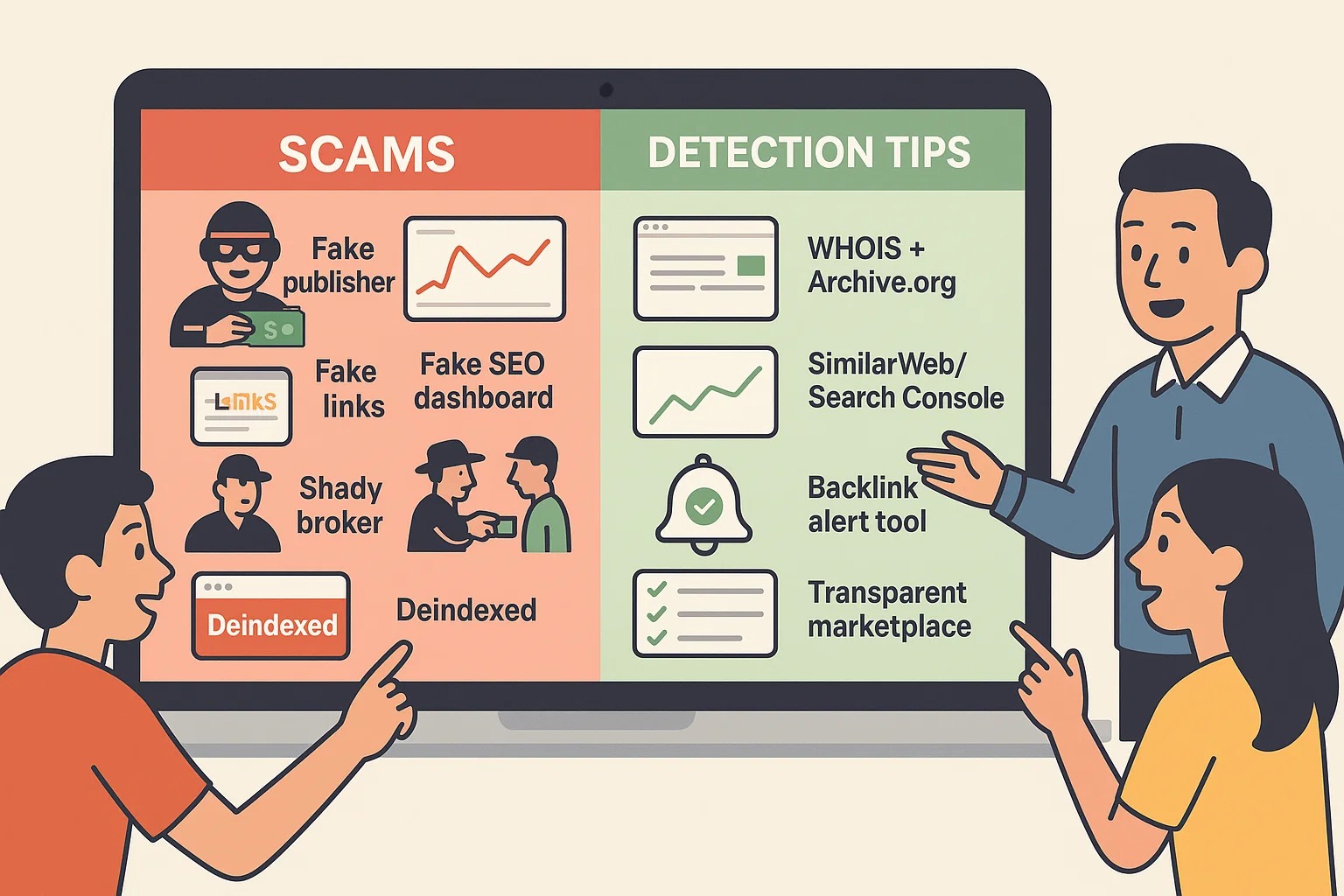
1. Fake Publishers or Hijacked Domains
Scammers impersonate site owners or use expired domains as legitimate blogs. They may take payment but never publish or delete content after a few weeks.
Detection Tip: Verify ownership using WHOIS data and Archive.org.
2. Fake Metrics Manipulation
Artificially inflated DR, DA, or traffic can mislead buyers. PBN links or bot traffic often create illusory domain authority.
Detection Tip: Cross-check traffic with SimilarWeb or Google Search Console. Watch for sudden DR spikes.
3. Link Injection Instead of Genuine Guest Posts
Some scammers insert links into existing content without disclosure. These links are often removed once indexed.
Detection Tip: Use backlink alerts via tools like MonitorBacklinks, or perform regular link audits.
4. Unethical Link Brokers & Middlemen
Middlemen resell guest post opportunities at inflated prices, hiding publisher details until payment. This can lead to link drops or low-quality placements.
Detection Tip: Vet platforms carefully and request live samples before engagement.
5. Google-Penalized or Deindexed Sites
Scammers may offer placements on sites already penalized or deindexed by Google.
Detection Tip: Use site:domain.com in Google to check indexing status.
Part 3: Case Study — Anatomy of a Guest Posting Scam
Scenario: High DR Blog Deal Gone Wrong
A client purchased five guest posts on blogs with DR 60+ via a Telegram broker.
After publishing, Ahrefs reported all five domains dropped 30+ DR points in a single week.
Investigation revealed the sites were part of a PBN ring with interlinking patterns.
Links were removed after indexing.
Lessons Learned:
Third-party verification is essential.
Monitor links long-term.
DR alone is insufficient to measure quality.
Part 4: How to Avoid Guest Post Scams
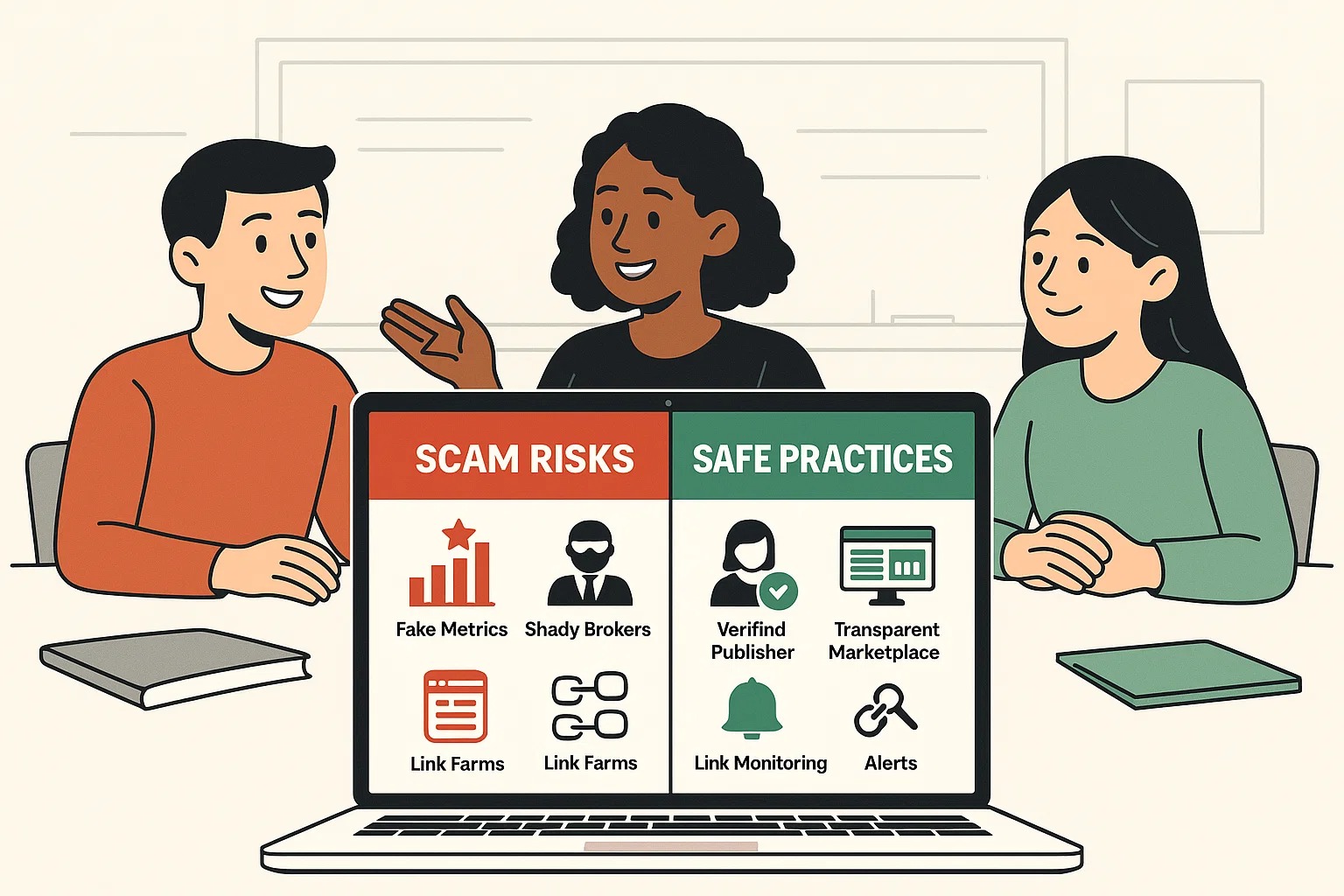
1. Vet the Publisher
Review domain history on Archive.org
Check organic traffic via SEMrush, Ahrefs, or SimilarWeb
Validate niche alignment and reader engagement
2. Use Transparent Marketplaces
Platforms like Rankar.ai, Adsy.com, WhitePress, or FATJOE
Look for: live URL previews, refund policies, and performance metrics (TF, DR, traffic, indexed pages)
3. Ask for Verification Data
Google Analytics screenshots
CMS screenshots (WordPress, Ghost, etc.)
Past guest posts for other clients
4. Monitor Link Status Post-Publication
Use automated backlink checkers like Ahrefs Alerts or MonitorBacklinks
Validate anchor text, page index status, and follow/nofollow tags
5. Maintain Blacklist and Whitelist Systems
Document low-quality or scamming domains
Share blacklist internally
Encourage publisher rating on platforms
Part 5: Industry Best Practices
Best Practice | Description |
|---|---|
Document Everything | Keep logs of communication, payment, and performance metrics |
Use Escrow or Platform Wallets | Avoid direct payments via crypto or wire transfer without platform mediation |
Develop Relationships | Build trust with recurring publishers rather than one-off vendors |
Segment Risk | Distribute backlinks across multiple domains and strategies |
Educate Your Team | Train agents to identify spammy or high-risk publishers |