
Why Relevancy and Authority Matter in Guest Posting
For SEO, Organic Growth & Brand PositioningExecutive SummaryIn the realm of Guest Posting for SEO, two key factors determine the effectiveness and risk...

For SEO, Organic Growth & Brand Positioning
Executive Summary
In the realm of Guest Posting for SEO, two key factors determine the effectiveness and risk profile of your backlinks:
Topical Relevance
Domain & Page-Level Authority
While many SEOs focus on domain metrics (such as DA/DR), neglecting to consider topical alignment often results in low-value or toxic backlinks. This guide explains why both relevance and authority matter — and how to engineer a guest posting strategy that enhances rankings and trust.
Key Definitions
Term | Definition |
Guest Posting | Publishing content on a third-party site that links back to your website. |
Topical Relevance | The degree to which the content and linking site align with your niche/theme. |
Domain Authority (DA) | A Moz metric predicting a site’s ability to rank in search engines (0-100). |
Domain Rating (DR) | An Ahrefs metric indicating the strength of a site’s backlink profile. |
Link Equity | The SEO value or "ranking power" passed from one page to another via a link. |
Anchor Text Relevance | The degree to which the hyperlink text reflects the target keyword or context. |
The Two Pillars - Relevance vs. Authority
Metric | Why It Matters | SEO Impact | Risk Profile |
Relevance | Google evaluates the topical similarity for link validity | Increases contextual trust | Safer, less likely to be penalized |
Authority | High-authority sites pass more link equity | Provides faster and stronger ranking boosts | Risky if not relevant |
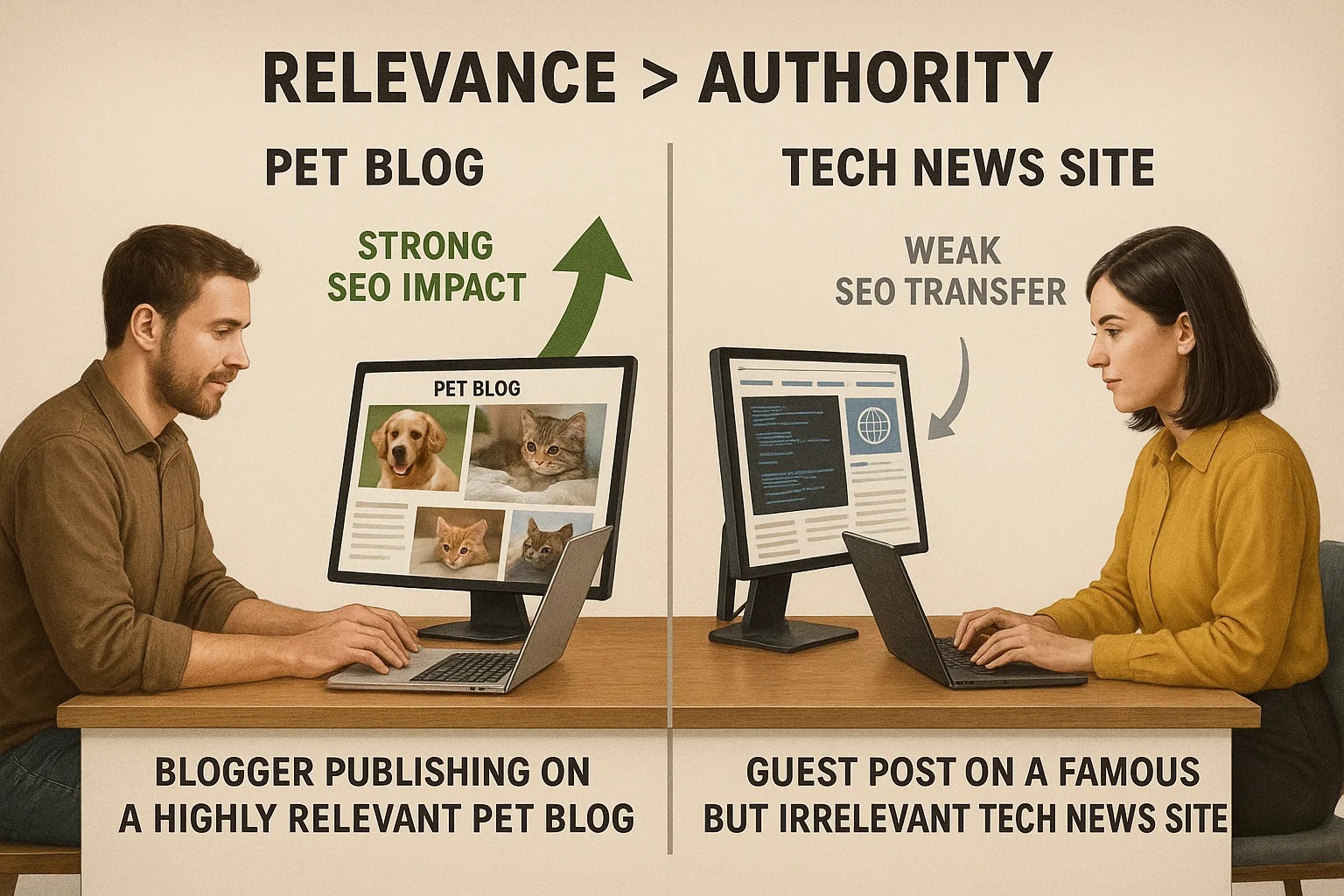
How Google Evaluates Backlinks
Google’s Link Quality Assessment Algorithm looks at the semantic relationship between:
The linking domain's theme
The page's topical content
The anchor text used
The linked page’s content
Google's Link Spam Update emphasised that contextual relevance is now a core ranking factor, and irrelevant links are either discounted or flagged.
Case Study - Relevance Beats DR Alone
Scenario | Linking Site | DR | Niche | Target Site | Outcome |
Tech news blog links to pet food brand | Tech | 78 | Tech | Pet eCommerce | Minimal impact |
Niche pet blog links to pet food brand | Pet | 45 | Pet | Pet eCommerce | Boosted organic ranking by 14% |
Even with lower DR, the relevant link outperformed the high-authority one.
Authority Deep Dive - How to Evaluate
Metric | Tool | What to Look For |
DR/DA | Ahrefs, Moz | 40+ is strong, but context matters |
Traffic | SimilarWeb, Ahrefs | Sites with real organic traffic are safer |
Referring Domains | Ahrefs | A natural-looking, diversified link profile |
Spam Score | Moz | Keep under 3% |
Index Status | Ensure the site is indexed |
Best Practices for Guest Post Targeting
Prioritize Relevance First
Use topical categories from Google’s NLP API to align content.
Don't link from irrelevant categories just for high DR.Use Thematic Anchor Text
Match the anchor text with the surrounding content.
Avoid exact-match spam unless it fits naturally within the context.Use Internal Metrics
Track performance by:Post-placement organic uplift
Keyword movement for the linked page
Referral traffic from the guest post
Diversify Link Sources
Use both high-DA niche sites and long-tail microblogs.
Avoid PBNs (Private Blog Networks) or overused platforms.
AI + Relevance - Rankar.ai Integration
Feature | Function |
AI Category Detection | Uses NLP to classify publisher content |
AI Anchor Suggestions | Suggests contextually relevant anchor text |
Relevance Score | Ranks suitability based on target content and domain |
Toxicity Check | Flags irrelevant links with high DR but low semantic match |
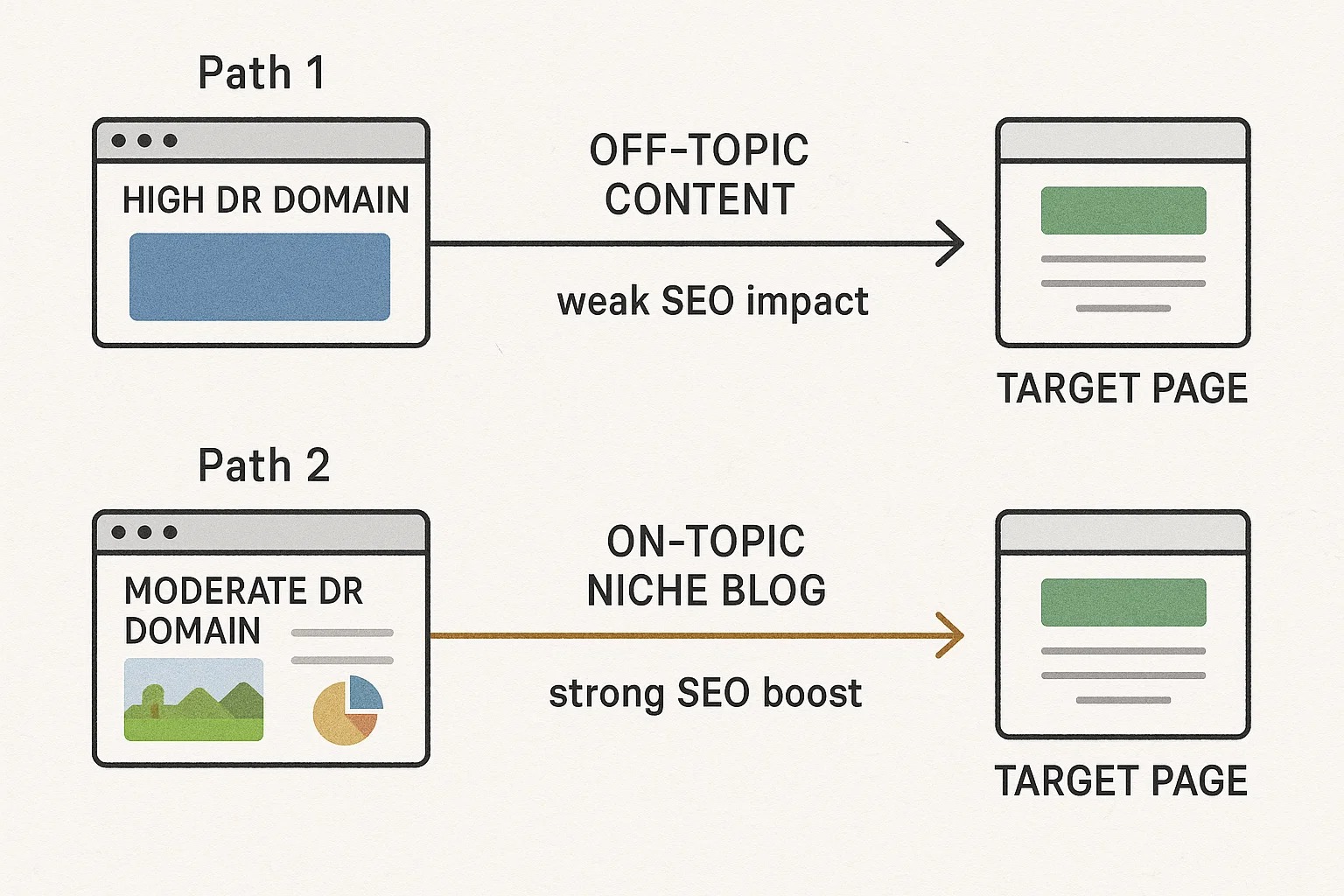
Diagram - How Relevance Flows SEO Value
[High DR Domain]
↓ (low relevance)
[Off-topic Content]
↓ (weak context)
[Target Page] – Minimal SEO impact
VS
[Moderate DR Domain]
↓ (high relevance)
[On-topic Niche Blog]
↓ (strong context + anchor relevance)
[Target Page] – Significant ranking impact
Actionable Insights
Action Item | Description |
Vet Relevance First | Use AI-based topic match tools like Rankar.ai or SurferSEO |
Match Anchor to Intent | Avoid forcing exact-match keywords |
Use Mixed Domain Sources | Combine high-authority domains and mid-tier niche blogs |
Track Post-Placement KPIs | Keyword uplift, traffic, backlinks, time-on-page |
Avoid Obvious Link Schemes | Google’s SpamBrain targets predictable patterns |
Final Thought
A powerful backlink does not have high DR. It’s the one that makes sense — to both Google and your readers.