RankAIO vs Traditional SEO Tools: What's Different?
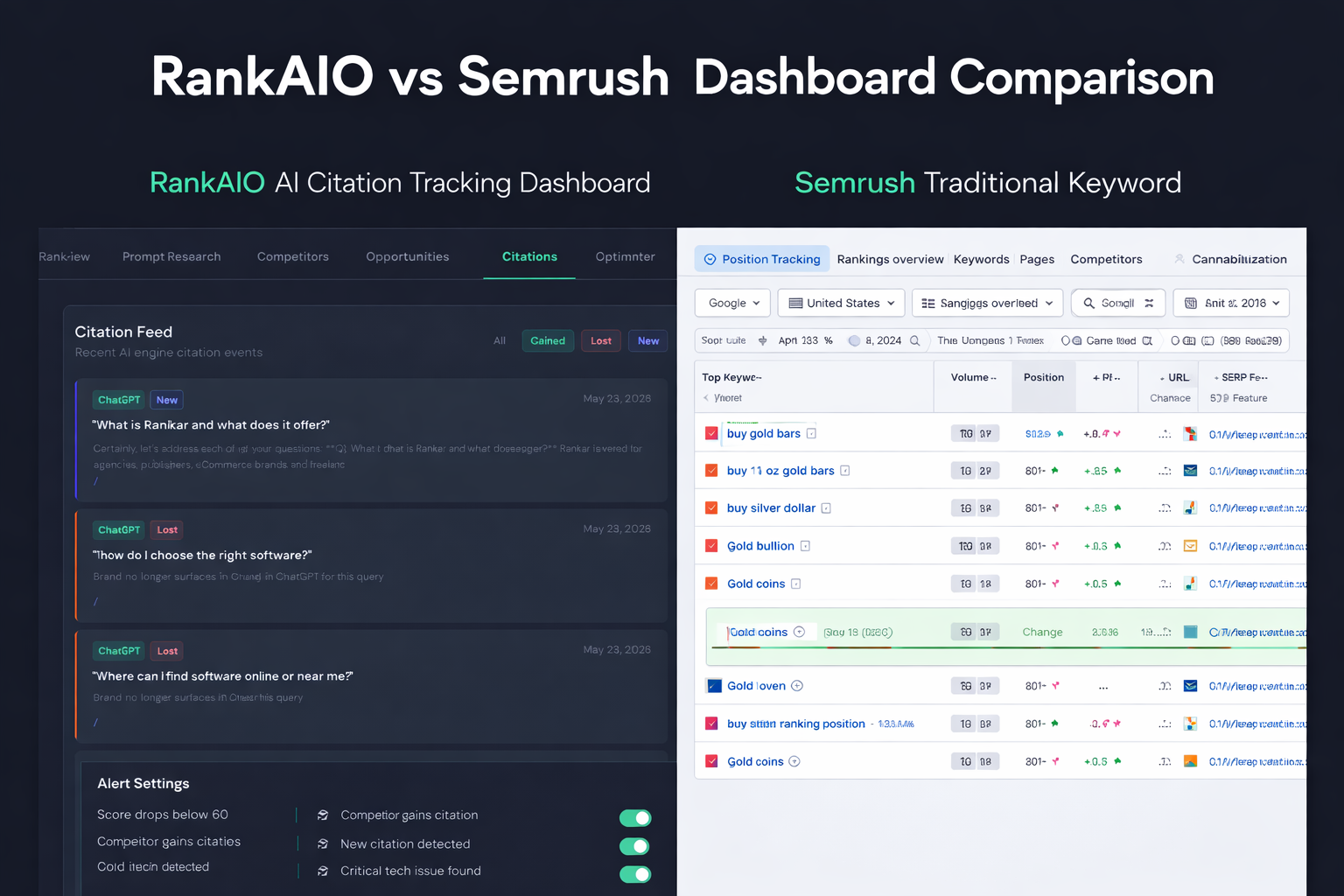
RankAIO vs traditional SEO tools explains how AI optimization differs from Google SEO, and why agencies need both tools to track visibility and search engines.
Introduction
Traditional SEO tools were built for a world where Google was the only search destination that mattered. They measure keyword rankings, backlink profiles, domain authority, and on-page optimization — and they do this brilliantly. But they were not designed to measure or optimize for the world where ChatGPT, Gemini, and Claude answer questions directly without ever sending users to a website.
As user behavior shifts toward conversational AI, the definition of “visibility” is fundamentally changing. Instead of ranking in a list of blue links, brands now compete to be included inside AI-generated answers, summaries, and recommendations. This shift introduces entirely new success metrics such as citation frequency, AI visibility scores, and prompt-based intent coverage. Most traditional SEO tools cannot capture this layer of data, leaving a major blind spot in modern digital strategies.
This article compares RankAIO with traditional SEO platforms to explain what is different, why those differences matter, and why forward-thinking agencies need both types of tools in their stack. It also highlights how combining SEO and AI optimization creates a more complete visibility strategy, ensuring brands remain discoverable across both search engines and AI systems that are rapidly becoming the new default information layer for users worldwide.
The Fundamental Problem with Using SEO Tools for AI
If you try to use a traditional SEO tool to track AI visibility, you will immediately encounter the core limitation: those tools have no visibility into what AI engines are saying. A brand can rank number one on Google and have an AI Visibility Score of 32 — invisible in the channel where millions of users are increasingly making their decisions.
Conversely, a brand with a modest Google presence can have excellent AI citation rates if it has well-structured, authoritative content on the right topics. Traditional SEO tools simply cannot see this — and neither can your clients, unless you give them a platform that can.
RankAIO vs Traditional SEO Tools: Head-to-Head
|
Dimension |
Traditional SEO Tool |
RankAIO |
|
Primary Channel |
Google Search |
ChatGPT, Gemini, Claude |
|
Core Metric |
Keyword ranking position |
AI Visibility Score (0–100) |
|
Competitive Intel |
Competitor keyword gaps |
Competitor citation gaps + query data |
|
Content Strategy |
Keyword volume & difficulty |
Prompt research + AI volume + intent |
|
Technical Audit |
Core Web Vitals, on-page |
Schema, AI crawlers, formatting, E-E-A-T |
|
Brand Monitoring |
Mention tracking (partial) |
Real-time AI citation feed |
|
User Journey |
User clicks link to site |
User gets answer in AI chat |
|
Optimization Target |
Page ranking signals |
Citation worthiness signals |
|
Reporting |
Rankings, organic traffic |
AI visibility score, citation gain/loss, AI ROI |
|
Built for Agencies |
Some agency features |
Agency-first multi-client portfolio |
Where Traditional SEO Tools Excel
To be clear: RankAIO is not a replacement for Semrush, Ahrefs, Moz, or similar platforms. Traditional SEO tools remain the best instruments for keyword research in Google, technical site audits for Core Web Vitals and crawlability, backlink analysis and link building strategy, and monitoring organic traffic trends. These capabilities are mission-critical and will remain so for years.
The right stack is RankAIO for AI visibility plus your existing SEO tool for Google visibility. Together, they give you complete coverage of how your clients are found.
Where RankAIO Does Things Differently
Prompt Research vs. Keyword Research
Traditional keyword research identifies what people type into Google. RankAIO's Prompt Research identifies what people type into AI chatbots — which is a fundamentally different input. AI prompts tend to be longer, more conversational, and more specific than search queries. They also carry clearer intent signals: a user asking ChatGPT 'what is the best CRM for a 10-person sales team with a $500 budget' has much stronger purchase intent than someone searching 'CRM software' on Google.

Citation Intelligence vs. Rank Tracking
Traditional SEO tools track where a URL appears in a ranked list. RankAIO tracks whether a brand is cited in a conversational answer — a qualitatively different measurement. Citation intelligence tells you not just whether you appear, but what the AI says about you, how you compare to competitors in the same response, and which queries are the most valuable citation opportunities.
AI-Specific Technical Audit
Traditional SEO audits focus on factors that affect Google crawling and ranking: page speed, mobile optimization, internal linking, and structured data for rich results. RankAIO's technical audit focuses on factors that affect AI citation probability: GPTBot access, llms.txt configuration, FAQ and HowTo schema, E-E-A-T signals, and direct-answer content formatting. Many of these factors are irrelevant to traditional SEO but critical to AI visibility.
Multi-Client AI Portfolio vs. Project Management
RankAIO is built agency-first. The Portfolio screen gives you a bird's-eye view of AI visibility across every client you manage — with health indicators, alert counts, score trends, and retainer values all visible at a glance. Traditional SEO tools have project management features, but none designed specifically around the AI visibility workflow.
Should You Replace Your SEO Tool with RankAIO?
No. The right answer is to use both. Your existing SEO tool handles Google. RankAIO handles AI. The two channels are complementary, and many of the signals that improve AI visibility — high-quality content, authoritative backlinks, robust structured data — also improve Google rankings. Think of RankAIO as the AI layer you add on top of your existing SEO stack, not as a replacement for it.
|
Traditional SEO Tool Covers |
RankAIO Covers |
|
Keyword research (Google) |
Prompt research (AI chatbots) |
|
Domain authority & backlinks |
AI Visibility Score |
|
Core Web Vitals audit |
AI crawler access audit |
|
Organic traffic analytics |
AI citation tracking |
|
SERP feature monitoring |
AI citation velocity |
|
On-page SEO scoring |
Content AI optimization scoring |
Recommendation: Present both tools' data to clients in the same monthly report. Showing Google and AI visibility together paints a complete picture of where the client appears across all major discovery channels.
Conclusion
Traditional SEO tools and RankAIO serve different channels and measure different things. As AI search grows as a discovery channel, the gap between agencies that measure AI visibility and those that do not will widen. RankAIO gives you the instrument to close that gap — not by replacing your existing toolkit, but by extending it into the channel that is reshaping how the world finds information.