Understanding the AI Citation Score SEO and AI Visibility
AI Citation Score is a modern SEO metric that measures a website’s or page’s influence across AI-powered search engines and LLM (Large Language Model)...
AI Citation Score is a modern SEO metric that measures a website’s or page’s influence across AI-powered search engines and LLM (Large Language Model) platforms (e.g., Rankwriter, ChatGPT, Perplexity.ai, Claude, Gemini). It reflects how frequently and authoritatively your content is being:
Cited or referenced by AI models
Ranked in AI-generated answers
Trusted by AI for knowledge retrieval

🔎 Key Concepts & Terminology
Term | Definition |
AI Citation | When a website is quoted or referenced in an AI-generated response |
Semantic Authority | Strength of meaning and relevance tied to your content |
LLM Visibility | How often a domain appears in AI model outputs |
Topical Relevance | Degree to which your content matches AI model's intent or subject |
Contextual Mentions | Natural references without hard links (citations within text) |
🧩 AI Citation Score Workflow (See diagram above)
Crawl Web Pages
LLMs like GPT, Claude, and others crawl web sources using:Custom AI crawlers
Integrated with Google/Bing SERPs
APIs like Common Crawl or DataForSEO
Extract Entities & Links
Identify branded mentions, URLs, and keywords
NLP techniques extract domain-authority signals
Analyze Link Context
Is the mention positive/neutral?
Is it in a high-quality editorial section?
Does anchor text show topic relevance?
Score Weighting
Combine authority metrics (DA, DR, traffic, etc.)
Sentiment analysis
Topic alignment and frequency across web
Compute AI Citation Score
On a scale of 0–100
Combines semantic trust + historical mentions + AI answer inclusion
How AI Citation Score Impacts Modern SEO Performance
🔍 Understanding the Real Value of AI Citation Score SEO
The evolution of search engines has shifted SEO beyond traditional ranking factors like backlinks and domain authority. Today, AI citation score SEO plays a critical role in determining how often a website is referenced, trusted, and surfaced by AI-driven platforms such as ChatGPT, Perplexity.ai, Claude, and Gemini.
Unlike traditional SEO metrics that rely heavily on keyword ranking, AI citation scoring focuses on semantic trust, contextual relevance, and content authority. This means your content is no longer just optimized for search engines—it is optimized for AI comprehension and citation behavior.
Websites with higher AI citation scores are more likely to appear in AI-generated answers, summaries, and recommendations, even if they are not ranking #1 on Google.
🧩 The Shift from Search Ranking to AI Visibility
Traditional SEO focused on SERP rankings. However, AI models do not rely solely on ranking positions. Instead, they evaluate:
- Content clarity and structure
- Entity recognition (brands, topics, authors)
- Contextual depth of information
- Trust signals across the web
This shift means a page can rank lower on Google but still be heavily cited in AI responses if it has strong semantic authority.
For example, a well-structured blog post on “guest posting strategies” may be frequently referenced by AI systems even if it is on page two of search results, simply because its content is clearer, more structured, and more informative.
🧠 How AI Models Decide What to Cite
AI systems follow a multi-layer evaluation process before citing any source. Understanding this process is key to improving your AI citation score SEO.
1. Content Extraction
AI systems scan large datasets and extract relevant content segments using NLP (Natural Language Processing). They break content into entities, topics, and key phrases.
2. Semantic Matching
The AI compares user queries with content meaning—not just keywords. Pages that answer intent clearly have a higher chance of being cited.
3. Authority Verification
AI checks trust signals such as:
- Domain reputation (DR/DA)
- Backlink profile quality
- Brand mentions across the web
4. Contextual Alignment
Content must match the context of the query. For example, a page about “SEO guest posting” will not be cited for “paid ads strategy” unless it has overlapping semantic relevance.
5. Frequency of Mentions
If a brand or domain appears consistently across multiple authoritative sources, AI systems assign higher citation confidence.
📊 Why AI Citation Score SEO Matters More Than Ever
The rise of AI search engines has changed user behavior. Instead of clicking multiple links, users now rely on direct AI-generated answers.
This creates a major shift:
- Fewer clicks from traditional SERPs
- Higher dependency on AI summaries
- Increased importance of being “cited” instead of just “ranked”
A high AI citation score ensures your content is part of these AI-generated responses, giving you:
- Brand visibility inside AI tools
- Increased authority perception
- Long-term organic traffic stability
- Higher trust from both users and algorithms
🚀 Practical Strategies to Improve AI Citation Score SEO
To improve your AI citation performance, you need to optimize for machine understanding, not just human readability.
🔹 1. Write Semantic-Rich Content
Avoid keyword stuffing. Instead, focus on topic depth, related entities, and natural language explanations.
🔹 2. Use Structured Formatting
AI prefers structured content:
- Headings (H2, H3)
- Bullet points
- Tables
- FAQs
🔹 3. Strengthen Entity Signals
Mention:
- Brands
- Tools
- Platforms
- Industry experts
This helps AI understand context and categorize your content correctly.
🔹 4. Build Topical Authority
Instead of writing random articles, build clusters around one niche. For example:
- Guest posting strategies
- SEO outreach systems
- Link-building workflows
🔹 5. Earn Contextual Backlinks
Not all backlinks are equal. AI prefers links from:
- Niche-relevant blogs
- High-authority editorial sites
- Contextually similar content pages
📈 Future of AI Citation Score SEO
As AI search continues to grow, citation scoring will become a primary ranking layer above traditional SEO signals. Instead of competing only for Google rankings, websites will compete for:
- AI answer inclusion
- Contextual referencing
- Knowledge graph visibility
In the near future, SEO success will depend on how well your content is understood and reused by AI systems—not just how it ranks in search engines.
Businesses that adapt early to AI citation optimization will gain a significant competitive advantage in visibility, traffic, and authority.
Feed AI Models
These scores influence which sources AI prefers in answers
Rank in AI Search Engines
Visibility in Perplexity, ChatGPT Search, and other LLMs increases
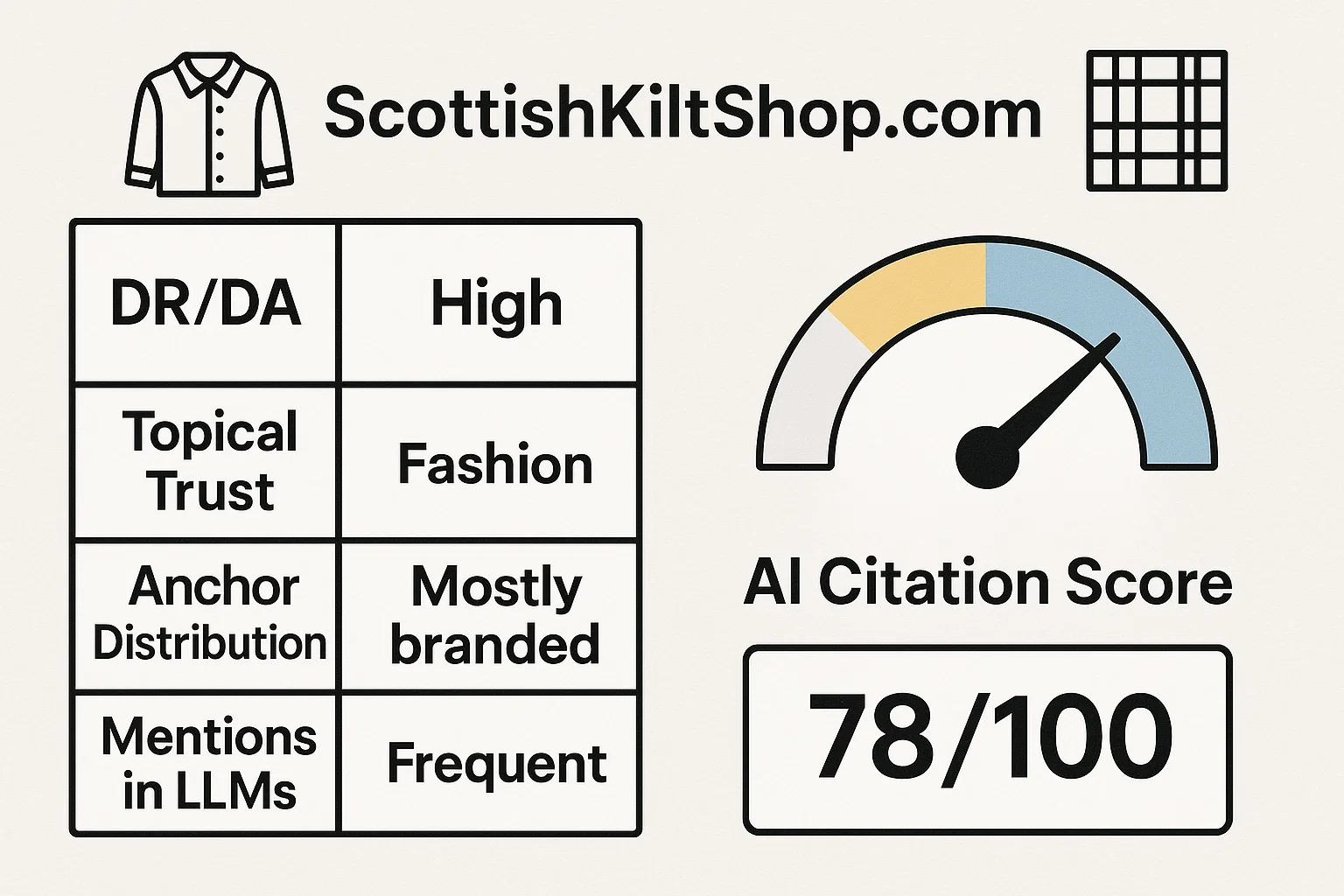
Case Study Example: ScottishKiltShop.com
Factor | Value |
DR/DA | High (via Ahrefs or Moz) |
Topical Trust | Strong in apparel, fashion |
Anchor Distribution | Mostly branded, some keyword-rich |
Mentions in LLMs | Frequently appears in niche fashion results |
AI Citation Score (Est.) | 78/100 (based on visibility, authority, topic match) |
Best Practices for Boosting AI Citation Score
Optimize for LLM Inclusion
Use structured data (FAQ, How-To, Product schema)
Mention your brand in natural language (contextual anchors)
Build Semantic Authority
Publish long-form, topical deep-dive content
Use GPT-style prompts to test your site's LLM visibility
Guest Post on Thematically Aligned Sites
AI understands topical clusters — a backlink from a relevant site matters more than just DA
Track Inclusion in AI Responses
Use tools like:
Prompt tools: “Mention 3 top {your niche} sites”
Additional Metrics to Track in Rankar.ai
Metric | Purpose |
AI Visibility Index | How often is a domain cited in AI-generated answers |
LLM Sentiment Index | Are mentions generally positive, neutral, or negative |
Contextual Mentions Count | Non-linked brand mentions across content |
Anchor Text Diversity Score | Measures over-optimization or brand trust |
Actionable Insights
Start offering AI Citation Reports for guest post buyers on Rankar.ai
Prioritize building backlinks from AI-favored websites (those ranking in ChatGPT, Perplexity, etc.)
Use your own Rank Writer AI to generate GPT-friendly, semantically rich guest post content