Understanding Guest Post Pricing Strategy Breakdown
Key TerminologiesUnderstanding the core terms is essential for guest post pricing and marketplace operations.TermDefinitionDomain Authority (DA/DR)Metric...
Key Terminologies
Understanding the core terms is essential for guest post pricing and marketplace operations.
Term | Definition |
|---|---|
Domain Authority (DA/DR) | Metric estimating how well a domain can rank on search engines (Moz/Ahrefs). |
Niche Relevance | Degree of alignment between your website’s topic and the backlink target site. |
Outbound Link Policy | Rules regarding how many and what type of outbound links are allowed per post. |
Content Guidelines | Editorial quality and format standards a contributor must follow. |
Traffic Quality | Evaluates whether traffic is organic, bot-heavy, or location-specific. |
Technical Pricing Factors
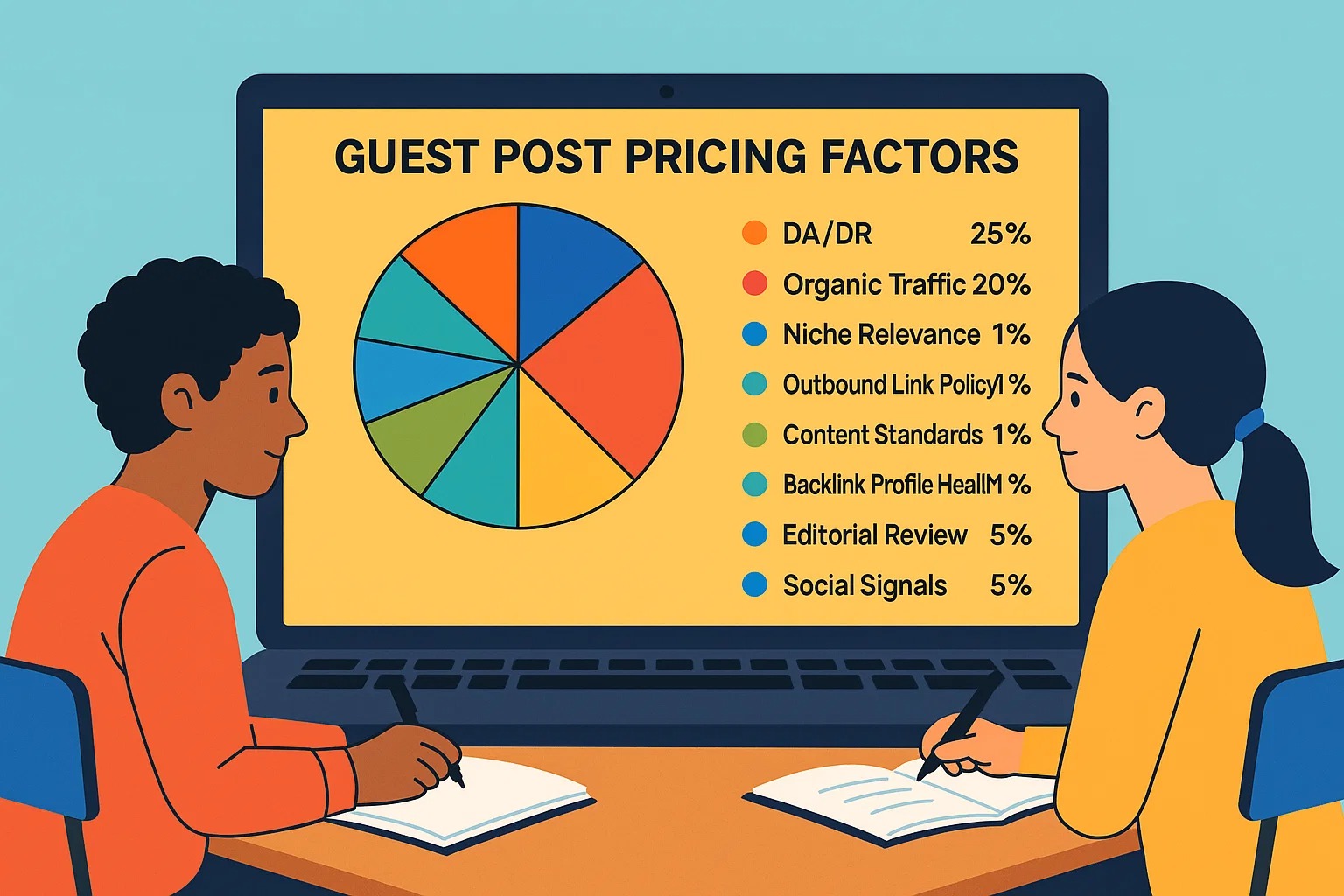
Pricing for guest posts depends on multiple weighted factors that measure domain authority, content quality, and engagement potential.
Factor | Description | Weight |
|---|---|---|
DA / DR | Higher DR (e.g., 60+) commands premium pricing. | 25% |
Organic Traffic | Verified monthly visits via SimilarWeb, Google Analytics, etc. | 20% |
Niche Relevance | Topical alignment improves SEO performance. | 15% |
Outbound Link Policy | Fewer outbound links allowed = higher editorial value. | 10% |
Content Standards | AI-written vs. editor-reviewed humanized content. | 10% |
Backlink Profile Health | Toxic or spammy backlinks reduce pricing. | 10% |
Editorial Review | Manual review, plagiarism checks, SEO audits justify higher rates. | 5% |
Social Signals | Social shares, comments, and interactions increase perceived value. | 5% |
Visualization: These factors can be visualized as a pie chart, highlighting the weight of each element in pricing calculation.
Building a Scalable Guest Post Pricing System for Long-Term Growth
To truly succeed with a guest post pricing strategy, you must move beyond static pricing tables and build a scalable system that adapts to market demand, SEO trends, and buyer behavior. A well-structured pricing system not only increases revenue but also positions your platform or website as a premium marketplace for high-quality backlinks.
🧱 Step 1: Create a Pricing Framework Based on Data Tiers
Instead of offering random pricing, categorize your inventory into structured tiers based on performance metrics:
- Tier 1 (Premium Sites): DR 60+, high organic traffic, strict editorial standards
- Tier 2 (Mid-Level Sites): DR 40–60, moderate traffic, consistent publishing
- Tier 3 (Entry-Level Sites): DR 20–40, niche-focused, emerging authority
Each tier should have a clear pricing range and value proposition. This simplifies decision-making for buyers and improves transparency in your marketplace.
📈 Step 2: Integrate Traffic Quality into Pricing Decisions
Traffic volume alone is not enough — traffic quality is what truly determines value. A site with 10,000 highly targeted visitors is often more valuable than one with 100,000 low-quality visits.
Evaluate:
- Geographic location of users (Tier 1 countries preferred)
- Bounce rate and session duration
- Keyword intent (informational vs. transactional)
By factoring in traffic quality, you can justify higher pricing and attract serious buyers who care about ROI.
🎯 Step 3: Align Pricing with Buyer Intent
Different buyers have different goals. Your pricing strategy should reflect this:
- SEO Agencies: Focus on DR, backlinks, and scalability
- Brands: Care about visibility, traffic, and audience alignment
- Affiliate Marketers: Prioritize conversions and niche relevance
By understanding buyer intent, you can create customized pricing packages that resonate with each segment.
💡 Step 4: Add Value-Driven Upsells
Upselling is one of the easiest ways to increase revenue without acquiring new customers. Enhance your guest post offerings with:
- Homepage feature placements
- Social media promotion
- Faster publishing (priority delivery)
- Content writing or optimization services
These add-ons increase perceived value and allow you to charge premium rates.
🤖 Step 5: Automate Pricing with AI & Data Models
Manual pricing is time-consuming and often inconsistent. By integrating AI-driven systems, you can automate pricing decisions based on real-time data.
AI can:
- Analyze domain metrics and suggest optimal pricing
- Detect pricing gaps compared to competitors
- Adjust rates based on demand and performance
This ensures your pricing remains competitive while maximizing profitability.
📦 Step 6: Build Subscription & Bulk Pricing Models
To attract agencies and long-term clients, offer bulk deals and subscription plans:
- 5 guest posts package (discounted rate)
- Monthly backlink subscription (e.g., 10 links/month)
- Enterprise SEO bundles with reporting and analytics
This creates predictable revenue streams and improves customer retention.
🔍 Step 7: Maintain Quality Control to Justify Pricing
Higher pricing must be backed by higher quality. Ensure:
- Strict editorial guidelines
- Limited outbound links per post
- Regular content audits
- Manual review of every submission
Quality control builds trust and allows you to sustain premium pricing over time.
🔄 Step 8: Monitor Market Trends & Adjust Pricing
The SEO landscape is constantly evolving. What works today may not work tomorrow. Regularly analyze:
- Competitor pricing strategies
- Niche demand fluctuations
- Changes in Google algorithms
Adjust your pricing accordingly to stay competitive and relevant.
🚀 Step 9: Build Brand Authority Around Your Pricing
Your pricing strategy is not just about numbers — it’s about positioning. If your platform is known for high-quality, trustworthy placements, buyers will be willing to pay more.
Focus on:
- Transparent metrics (DR, traffic, niche relevance)
- Verified publisher badges
- Case studies and success stories
- Clear refund and quality policies
Strong branding reinforces your pricing and increases buyer confidence.
📊 Step 10: Track ROI and Optimize Continuously
Finally, measure the effectiveness of your pricing strategy using:
- Revenue per listing
- Conversion rate
- Customer lifetime value (LTV)
- Repeat purchase rate
Use these insights to refine your pricing model and eliminate underperforming segments.
Price Calculation Model
Pricing varies based on DA, monthly traffic, and niche relevance. Example ranges:
DA | Monthly Traffic | Niche Relevance | Base Price (USD) |
|---|---|---|---|
30 | 5,000 | Medium | $40–60 |
50 | 50,000 | High | $150–200 |
70+ | 100,000+ | Very High | $400–1,000 |
Tip: Apply a multiplier for highly niche-specific sites (e.g., a health blog with high DR could command 2× pricing).
Best Practices
Always Vet Submissions: Combine AI tools with manual checks to maintain editorial quality.
Don’t Over-Monetize: Excessive guest posts may lower editorial trust and affect Google rankings.
Offer Packages: Provide flexible plans (1 post, 5 posts, monthly subscriptions) to attract agencies.
Use AI Scoring Tools: Integrate platforms like DataForSEO, Ahrefs API, or SurferSEO to validate rankings and establish minimum thresholds.
Actionable AI Integration
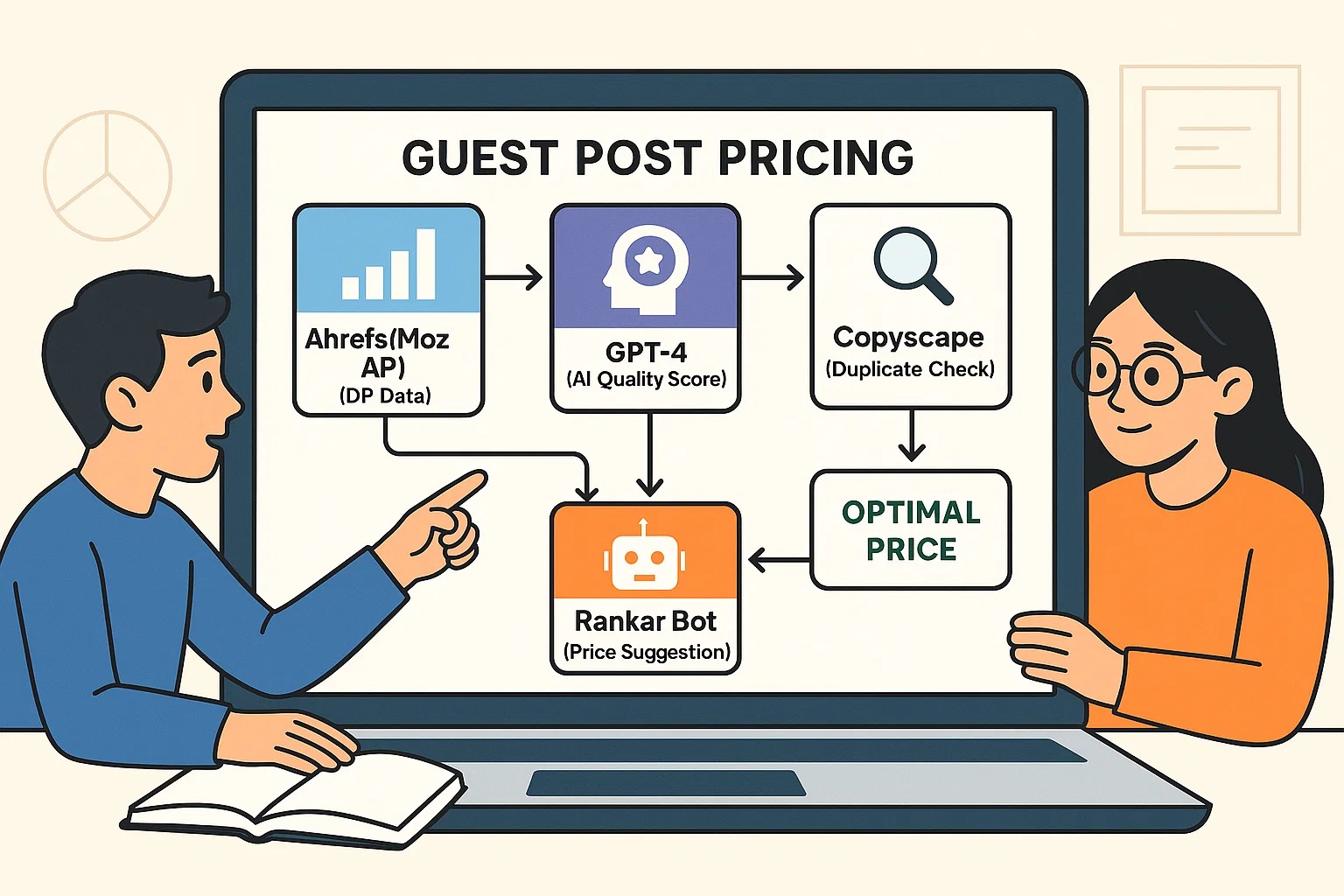
AI tools can streamline guest post pricing, quality checks, and automation.
Feature | Tool | Description |
|---|---|---|
DR / Backlink Data | Ahrefs / Moz API | Fetch DR, backlinks, and anchor text data |
AI-Quality Score | OpenAI / GPT-4 | Evaluate content originality, tone, and relevance |
Price Suggestion Bot | Rankar Custom Tool | Calculate optimal price per post |
Duplicate Check | Copyscape API | Ensure content originality |
Monetization Strategy
Several monetization options can be applied for a guest post marketplace or agency:
Free Listing + Commission on Sale: 10–15% of each guest post purchase
Premium Verified Publisher Badge: Reward sites with strong editorial integrity
SEO Pack Add-ons:
AI content writing
Custom outreach templates
DFY (Done For You) campaigns