Internal Linking Strategy — Distribute Authority to Every Page
Internal linking is a powerful SEO strategy that improves crawlability, passes authority, and boosts rankings. Learn how to use internal linking effectively in 2025.
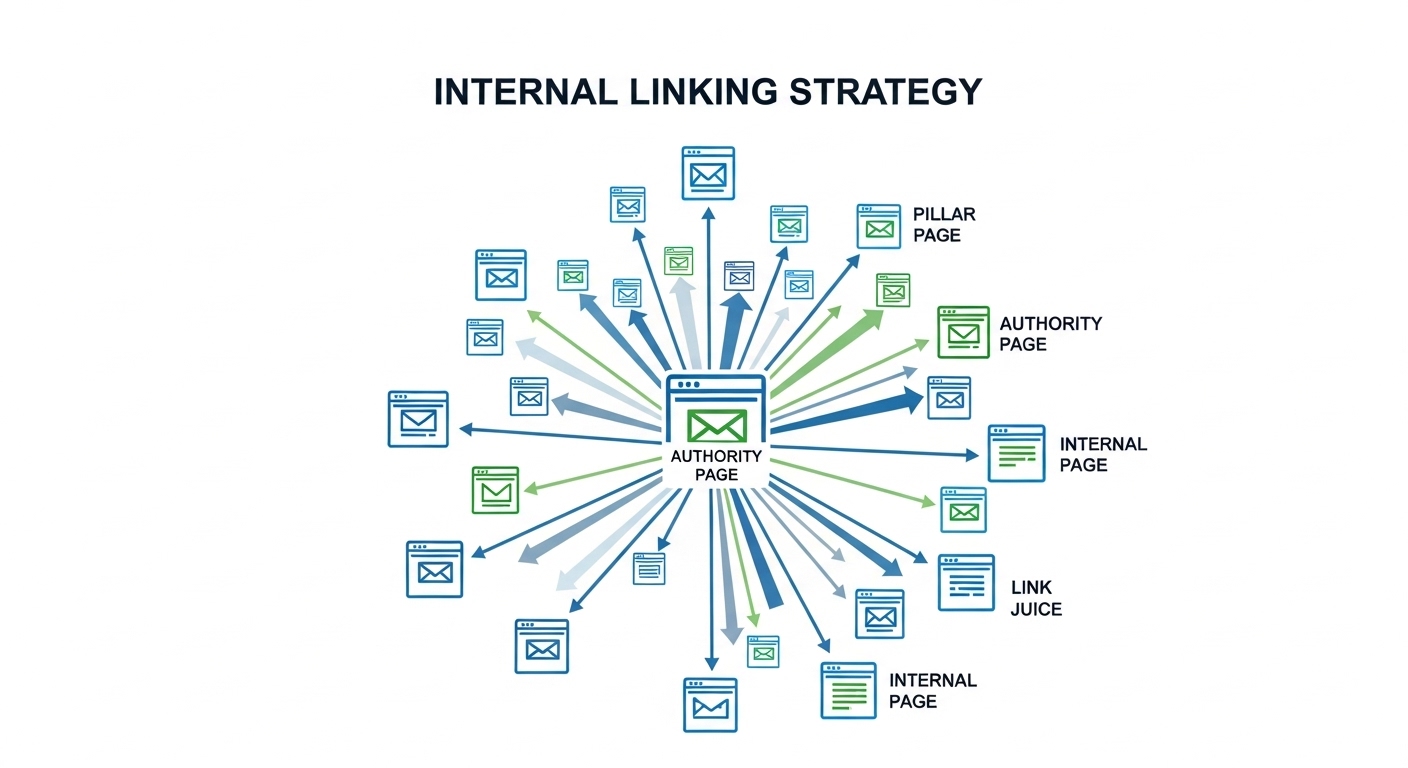
How Internal Links Transfer Authority
PageRank — Google's measure of page-level authority — flows through links. When a high-authority page on your site links to a lower-authority page, some of that authority is transferred. This is exactly how external backlinks work, except you have complete control over internal links. You can deliberately direct authority to the pages you most want to rank.
Think of it like water flowing through pipes. Your homepage typically has the most external backlinks, meaning authority flows in there first. Internal links are the pipes that distribute that authority throughout your site. Pages with no internal links pointing to them are isolated reservoirs — authority cannot reach them, so they cannot rank regardless of how good their content is.
The Orphaned Page Problem
An orphaned page is a page that has no internal links pointing to it from anywhere else on your site. Googlebot discovers pages primarily by following links — so orphaned pages may never be crawled, or crawled so rarely that they effectively do not exist in Google's active index.
Orphaned pages are extremely common. They happen when you publish content but forget to link to it from existing pages, when a category page exists but is not linked from the main navigation, when old content sits in archives that are not linked from anywhere current, or when product pages exist in the database but do not appear in any category listing.
|
⚠️ COMMON MISTAKE |
|
Run a RankAudit crawl of your site and filter for pages with zero internal inlinks. Every page in that list is an orphan. Fix it by adding relevant contextual links from related content that Googlebot visits regularly. This single fix can dramatically improve the crawl frequency and indexation status of previously invisible pages. |
The 3-Click Rule — Site Architecture Principle
A foundational principle of internal linking is that no important page should be more than three clicks from the homepage. Pages deep in your site architecture — requiring five, six, or seven clicks to reach from the homepage — receive very little PageRank and are rarely recrawled. They cannot rank, even if the content is excellent.
Audit your site's click depth by mapping the minimum number of clicks needed to reach each page from the homepage. Anything beyond three clicks needs either: a direct link added from a higher-level page, restructured navigation, or consolidation with a related page that is already well-linked.
Anchor Text Strategy for Internal Links
The anchor text of an internal link — the clickable words — tells Google what the destination page is about. This is a significant relevance signal, and one that is far more controllable and less risky than external anchor text optimisation.
Why Internal Linking is the Backbone of SEO Architecture
Internal linking is not just a technical SEO practice — it is the structural foundation of how search engines understand your website. Without a strong internal linking system, even high-quality content struggles to gain visibility because Google cannot properly interpret the relationship between your pages. Every internal link acts as a signal that connects one piece of content to another, helping Google build a clear map of your website’s structure, hierarchy, and topical relevance.
A well-designed internal linking system ensures that authority is not trapped in isolated pages but flows naturally across the entire website. This flow of authority allows newer pages to benefit from older, established pages that already have backlinks and trust signals. At the same time, it helps Google discover new pages faster and understand which pages are most important within your site.
Another major benefit of internal linking is improved user engagement. When users are guided through relevant content in a logical sequence, they spend more time on your website, visit multiple pages, and are more likely to convert. This sends positive behavioral signals to Google, reinforcing your site’s authority.
From an SEO perspective, internal linking also helps distribute keyword relevance across your website. When you link related pages together using contextually relevant anchor text, you strengthen topical clusters and make it easier for Google to understand your niche authority.
In short, internal linking is not optional — it is a critical system that determines how well your content performs in search results.
|
Anchor Text Type |
Example |
When to Use |
|
Exact-match keyword |
"keyword research tools" |
When it reads naturally in the surrounding sentence. Do not force it. |
|
Partial-match / topical |
"our guide to finding keywords" |
Most common type — sounds natural and still signals the topic clearly. |
|
Branded |
"RankTracker's keyword module" |
For linking to tool pages and product features. |
|
Descriptive |
"this checklist covers all 15 elements" |
When describing what the reader will find on the destination page. |
|
Generic (avoid) |
"click here" or "read more" |
Never for SEO — provides zero topical signal to Google. |
|
💡 KEY INSIGHT |
|
Vary your anchor text across multiple links to the same destination page. Using the exact same anchor text every time looks unnatural in Google's link graph. Use semantic variations: "keyword research process,""finding the right keywords,""our keyword strategy guide" — all signal the same topic without the repetition pattern that can trigger spam filters. |
Pillar Pages and Content Clusters — The Modern Architecture
The most powerful internal linking structure is the pillar page and content cluster model. A pillar page covers a broad topic comprehensively and links out to cluster articles that cover specific subtopics in depth. Cluster articles link back to the pillar page and to each other. This creates a topical web that Google reads as comprehensive authority on a subject.
Example for an SEO tool company:
• Pillar page:"The Complete Guide to Link Building" — covers all aspects, links out to 10 cluster articles
• Cluster articles:"Broken Link Building,""Digital PR for Links,""Outreach Email Templates,""Anchor Text Strategy" — each links back to the pillar and to 2–3 other cluster articles
The result: Google understands that your site has deep, comprehensive coverage of the link building topic. The pillar page accumulates authority from all the cluster articles linking to it, and that authority is redistributed back out to the clusters. Every page in the cluster benefits from the others.
Internal linking is not just about SEO signals — it is also a powerful way to shape how users experience your website. When done correctly, it creates a clear path that guides visitors from one piece of content to another, helping them discover more valuable information without needing to return to Google. This increases session duration, reduces bounce rate, and improves engagement metrics, all of which indirectly support higher rankings over time.
One of the most effective ways to improve internal linking is to build a structured content map before publishing new articles. Instead of writing content randomly, you should plan how each page will connect to others within the same topic cluster. This ensures that every new article strengthens existing pages rather than standing alone. For example, if you publish a new article on “keyword difficulty,” you should immediately link it to related pages such as “keyword research,” “SEO tools,” and “content optimization strategy.” At the same time, those older pages should also be updated to link back to the new article.
Another important practice is contextual linking. Internal links placed naturally within the body content carry far more SEO value than links placed in footers or sidebars. Google gives more weight to links surrounded by relevant text because they provide stronger context about the destination page. This means your internal links should feel like a natural part of the reading flow, not forced insertions.
It is also important to regularly audit your internal link structure as your website grows. Over time, older pages may lose visibility while new pages remain underlinked. A monthly or quarterly internal linking review helps you identify these gaps and redistribute authority more effectively across your site. This ongoing process ensures that no important page is left isolated and that your entire website continues to grow in a balanced and structured way.
Four Practical Internal Linking Rules
1. Every new piece of content gets at least 3 inbound internal links on publication day. Before hitting publish, identify 3 existing pages that are topically related and add a contextual link to your new content from each. Do not wait for Googlebot to find it organically — direct it there immediately.
2. Every page should link out to 3–5 related pages. The internal links you send out are as important as the ones you receive. Contextual outbound internal links improve user experience, help Google map your content structure, and share authority to pages that need it.
3. Link from high-authority pages to the pages you most want to rank. Your highest-traffic, most externally-linked pages are your authority sources. Check what they link to internally, and add new links from them to your target pages.
4. Audit and refresh internal links quarterly. As you publish new content, old pages become opportunities to add links to that new content. A quarterly internal link audit finds every page that could link to your newest content but currently does not.
✓ Key Takeaways
✓ Internal links transfer PageRank — you have complete control over where authority flows within your site. Use that control deliberately.
✓ Orphaned pages (zero internal inlinks) may never be crawled or indexed regardless of content quality. Find and fix them with a crawl audit.
✓ No important page should require more than 3 clicks from the homepage — deeper pages receive minimal crawl frequency and authority.
✓ Use descriptive, varied anchor text for internal links. Never use 'click here.' Never use the exact same anchor text to the same page every time.
✓ The pillar page + content cluster model is the most powerful internal link architecture for building topical authority at scale.
✓ Add 3 inbound internal links to every new piece of content on publish day — do not wait for Googlebot to discover it organically.