On-Page SEO — The Complete 2025 Optimisation Checklist
On-page SEO is the foundation of ranking success. Learn how to optimize title tags, content, headings, and structure using a complete on-page SEO checklist for 2025.
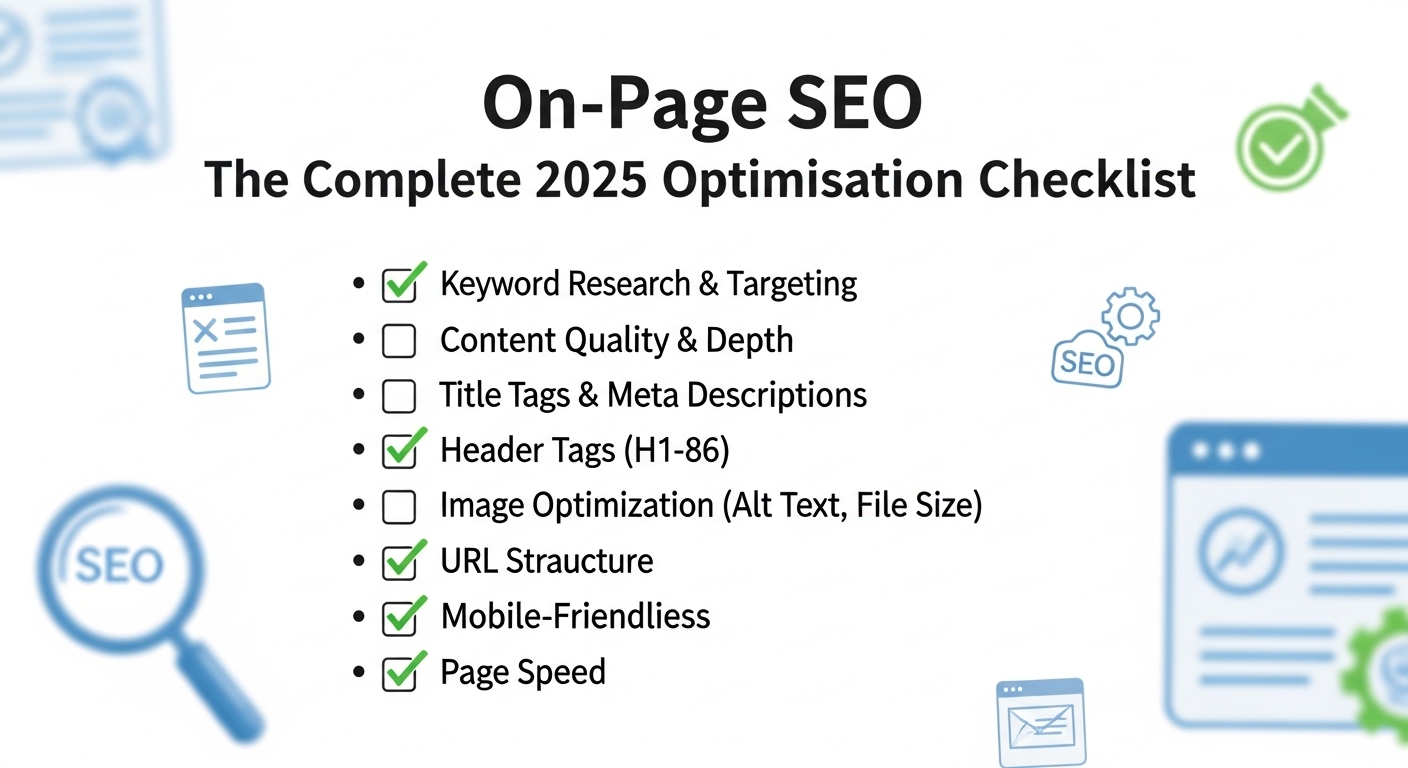
On-page SEO covers every element on a web page that signals its relevance, quality, and topic to search engines. Before backlinks, before technical infrastructure — a page must be correctly optimised or everything else is wasted effort. This lesson walks through every on-page element that matters in 2025, with specific guidance on how to optimise each one and a complete checklist you can run on any page in under 20 minutes.
Why On-Page SEO Matters More Than Ever
Google's algorithms have evolved significantly. In 2025, on-page SEO is no longer just about putting keywords in the right places — it is about communicating the full topic, quality, and trustworthiness of a page through its content, structure, and signals. Pages that do this well rank higher and stay ranked longer than pages that only target keywords mechanically.
The good news: on-page optimisation is entirely within your control. You do not need to wait for backlinks or algorithm updates. Fix your on-page elements today and you can see ranking improvements within two to six weeks.
Element 1: Title Tags — The Most Important On-Page Signal
The title tag is the blue clickable headline in Google's search results. It is the single most impactful on-page SEO element because it directly tells Google the primary topic of a page. It also determines whether searchers click your result or a competitor's.
The ideal title tag formula:
[Primary Keyword] — [Compelling Benefit or Differentiator] | [Brand Name]
Example: "On-Page SEO Checklist 2025 — 47 Checks Every Site Needs | RankAudit"
Rules for title tags:
• Keep between 50–60 characters to avoid truncation in search results
• Place the primary keyword as close to the beginning as possible — Google weights earlier words more heavily
• Every page must have a unique title tag — duplicates confuse Google and split ranking signals
• Include a value proposition or specific differentiator when the keyword alone would not compel a click
• Avoid keyword stuffing — writing "SEO SEO Tools Best SEO Software" signals spam, not quality
Element 2: Meta Descriptions — Your 155-Character Advertisement
Meta descriptions do not directly affect rankings, but they massively affect click-through rate — which signals quality to Google and compounds into better rankings over time. Your meta description is your advertisement in search results. Every character counts.
Write in active voice, include the primary keyword (Google bolds it in the SERP, increasing visual prominence), state a clear benefit to the searcher, and end with a subtle call to action. Stay under 155 characters.
⚠️ COMMON MISTAKE
Google rewrites meta descriptions approximately 70% of the time — pulling text directly from your page content that better matches the query. This does not mean you should not write one. When Google uses your meta description as written, your CTR will be measurably higher than if Google generates a generic snippet. Always write a compelling meta description. The 30% of the time it is used exactly, it earns its keep.
Element 3: Heading Structure (H1 through H3)
Headings communicate your page's topic hierarchy to both users and search engines. Google reads your heading structure to understand the full breadth of topics your page covers — which determines what long-tail keyword variations it will rank your page for.
Heading Level
Role
Best Practice
H1
Page title — your primary topic
Exactly one H1 per page. Must contain your primary keyword.
H2
Main section headings
Use for major topic sections. Include secondary keywords naturally.
H3
Subsection headings
Use for sub-topics within H2 sections. Include long-tail keyword variations.
H4–H6
Rarely necessary
Only use if you genuinely have that level of content hierarchy.
Element 4: Content Quality — The E-E-A-T Standard
Content quality in 2025 is evaluated through Google's E-E-A-T framework: Experience, Expertise, Authoritativeness, and Trustworthiness. This is not just about word count — it is about demonstrating genuine knowledge that serves the searcher's needs completely and better than any competing page.
• Comprehensive coverage. Cover the full topic — not just the surface. Address the questions searchers have before and after the main topic. Go deeper than any competing page.
• Original insights. Include data, case studies, examples, or perspectives that cannot be found anywhere else. This is what makes content genuinely worth linking to.
• Regular updates. Outdated content loses rankings. Add a "Last Updated" date, refresh statistics annually, and update recommendations when tools or best practices change.
• Named author with credentials. Include an author byline linking to a detailed biography page with their professional background. Named authors with verifiable expertise significantly boost E-E-A-T signals.
Element 5: Keyword Placement — Where and How to Use Keywords
In 2025, keyword density — stuffing keywords a specific percentage of times — is not a ranking strategy. It is a spam signal. Use your primary and secondary keywords naturally in the locations that carry the most weight:
Location
Priority
Note
Title tag
Critical
Primary keyword, ideally at or near the start
H1 heading
Critical
Same as or very similar to the title tag
First 100 words
High
Mention the primary keyword naturally in the opening paragraph
H2 and H3 headings
High
Secondary keywords and topic variations
Image alt text
Medium
Descriptive text that includes relevant keywords where it reads naturally
URL slug
Medium
Primary keyword, hyphens as separators, no stop words
Meta description
Medium
Primary keyword included naturally — Google bolds it in results
Element 6: URL Structure — Clean, Descriptive, and Permanent
Good URL: rankar.ai/academy/on-page-seo-checklist
Bad URL: rankar.ai/page?id=482&session=abc123&ref=homepage
Important: once a URL is published and indexed, do not change it without implementing a 301 redirect. URL changes break backlinks, lose ranking signals, and temporarily drop your traffic while Google re-crawls and reassociates the content. Plan your URL structure carefully before publishing.
Element 7: Image Optimisation
• Compress all images to under 100KB for most web images. Use WebP format — smaller file size than JPEG with equivalent quality.
• Always include descriptive alt text — describes the image for screen readers and tells Google what the image shows. Include relevant keywords where it reads naturally.
• Use descriptive filenames — "on-page-seo-checklist.webp" communicates to Google. "IMG_00483.jpg" communicates nothing.
• Set explicit width and height attributes on all img tags — this prevents layout shift (CLS) while the image loads, protecting your Core Web Vitals score.
The Complete On-Page SEO Checklist
Run through this checklist on every page before publishing, and quarterly for existing content:
• Title tag: 50–60 characters, primary keyword near the start, unique per page
• Meta description: under 155 characters, includes keyword, has a clear value proposition
• Exactly one H1 heading containing the primary keyword
• H2 and H3 headings cover topic breadth with secondary keywords
• Primary keyword appears naturally in the first 100 words of body text
• URL is clean, descriptive, uses hyphens, omits stop words
• All images have descriptive alt text and file sizes under 100KB
• Content covers the full topic comprehensively — check competitor depth and match or exceed it
• Named author byline with a link to credentials or biography page
• At least 3 internal links from related existing pages pointing to this page
• At least 3 contextual internal links from this page to related content
• Page is mobile-responsive with no horizontal scrolling
• Page loads under 2.5 seconds — check with Google PageSpeed Insights
• Self-referencing canonical tag pointing to the preferred URL
• No noindex meta tag unless this page is intentionally excluded from search
Internal linking is one of the most underrated yet powerful on-page SEO techniques. It helps search engines understand the relationship between different pages on your website and distributes authority across your content. When you link from one page to another using relevant anchor text, you are signaling to Google what the linked page is about and which keywords it should rank for. This improves both crawling efficiency and ranking potential.
A strong internal linking strategy ensures that your most important pages receive the highest number of internal links. These are usually your core service pages, pillar content, or high-converting blog posts. At the same time, supporting articles should link back to these main pages using descriptive and keyword-rich anchor text. Avoid using generic phrases like “click here” — instead, use meaningful anchors like “on-page SEO checklist” or “SEO content optimization guide.”
Additionally, internal links improve user experience by guiding visitors to related content, increasing time on site and reducing bounce rate. Both are positive engagement signals that indirectly support higher rankings. As a best practice, aim to include at least 3 to 5 internal links per page, ensuring they are contextually relevant and naturally placed within the content.
✓ Key Takeaways
✓ Title tags are the most impactful on-page element — primary keyword early, unique per page, 50–60 characters.
✓ Meta descriptions don't affect rankings directly but significantly impact click-through rate. Write them as compelling advertisements.
✓ Use exactly one H1; use H2 and H3 to cover topic breadth and secondary keyword variations.
✓ Content quality in 2025 means comprehensive coverage, original insights, named authors with credentials, and regular updates.
✓ URLs should be clean, descriptive, and permanent — changing them without 301 redirects loses ranking signals and backlink value.
✓ Compress all images, always include alt text, and set explicit width and height attributes to prevent layout shift.
✓ Run the 15-point checklist on every page before publishing and quarterly for all existing content.
