Creating a Winning Guest Post Portfolio That Brings Clients
A Guest Post Portfolio is your SEO credibility deck. It's a curated collection of your published guest posts, organized to demonstrate your value, niche...
A Guest Post Portfolio is your SEO credibility deck. It's a curated collection of your published guest posts, organized to demonstrate your value, niche relevance, backlink quality, writing authority, and industry influence. A well-built portfolio is essential for attracting clients and establishing trust.
What Is a Guest Post Portfolio?
A Guest Post Portfolio is a collection of your published guest posts across authoritative websites. It is organized in a way that showcases:
Domain Authority (DA/DR): Demonstrates high-value platforms
Niche Relevance: Ensures your content aligns with client needs
Anchor Text Strategy: Displays effective backlink placement
Traffic Metrics: Shows the visibility of your posts
Follow/NoFollow Links: Balances the backlink profile
Indexation Status: Ensures the links are indexed by Google
Portfolio Foundation - Core Elements
Key Elements to Include:
Element | Description | Why It Matters |
Domain Authority (DA/DR) | Measures the strength of a site’s backlink profile | Shows you're posting on high-value platforms |
Niche Relevance | How closely the content aligns with your client's niche | Boosts topical authority and prevents spammy links |
Anchor Text Strategy | The clickable text in backlinks | Impacts rankings and creates a natural link profile |
Traffic Metrics | Estimated monthly visits (Ahrefs, SimilarWeb) | Indicates the visibility and engagement of the link |
Follow/NoFollow | Whether the link passes authority or not | Balances link profile, providing diversity |
Indexation Status | Whether the post is indexed by Google | Ensures effectiveness of backlinks |

Advanced Strategy: Building the Portfolio
Step 1: Define Your Guest Post Identity
Before building your portfolio, you need to decide on your specialization. Choose a clear identity that fits your strengths and market demands:
Generalist Guest Poster: Targets many industries, often at lower pricing
Niche Specialist: E.g., "SaaS SEO Backlink Expert" or "eCommerce Link Builder"
Authority Builder: Only works with DR 70+ sites, charges premium rates
Pro Tip: A niche-focused identity helps you command higher retainers and gain client referrals more easily.
Step 2: Choose Target Websites
Create a matrix using the RANK-METHOD Framework to select quality sites for guest posts.
Factor | Weighting (1-5) | Notes |
Relevance | 5 | Must align with niche/industry |
Authority (DA/DR) | 4 | Target DR 40+ (Tier 1) or DR 20-40 (Tier 2) |
Natural Traffic | 5 | 1K+ monthly visits minimum |
Knowledge Graph | 3 | Brand/author presence matters for trust |
Metrics (TTF/CTR) | 4 | Time-to-first-link & Click-through potential |
Use the following tools to extract this data:
Ahrefs or SEMrush
Rankar.ai for verified guest post data
Step 3: Optimize for Anchor Text & Link Placement
A strong portfolio will display both anchor diversity and contextual link placement.
What Not to Do
Avoid using exact-match anchors repeatedly
Don't place links only in author bios
Avoid linking from low-quality or spun content
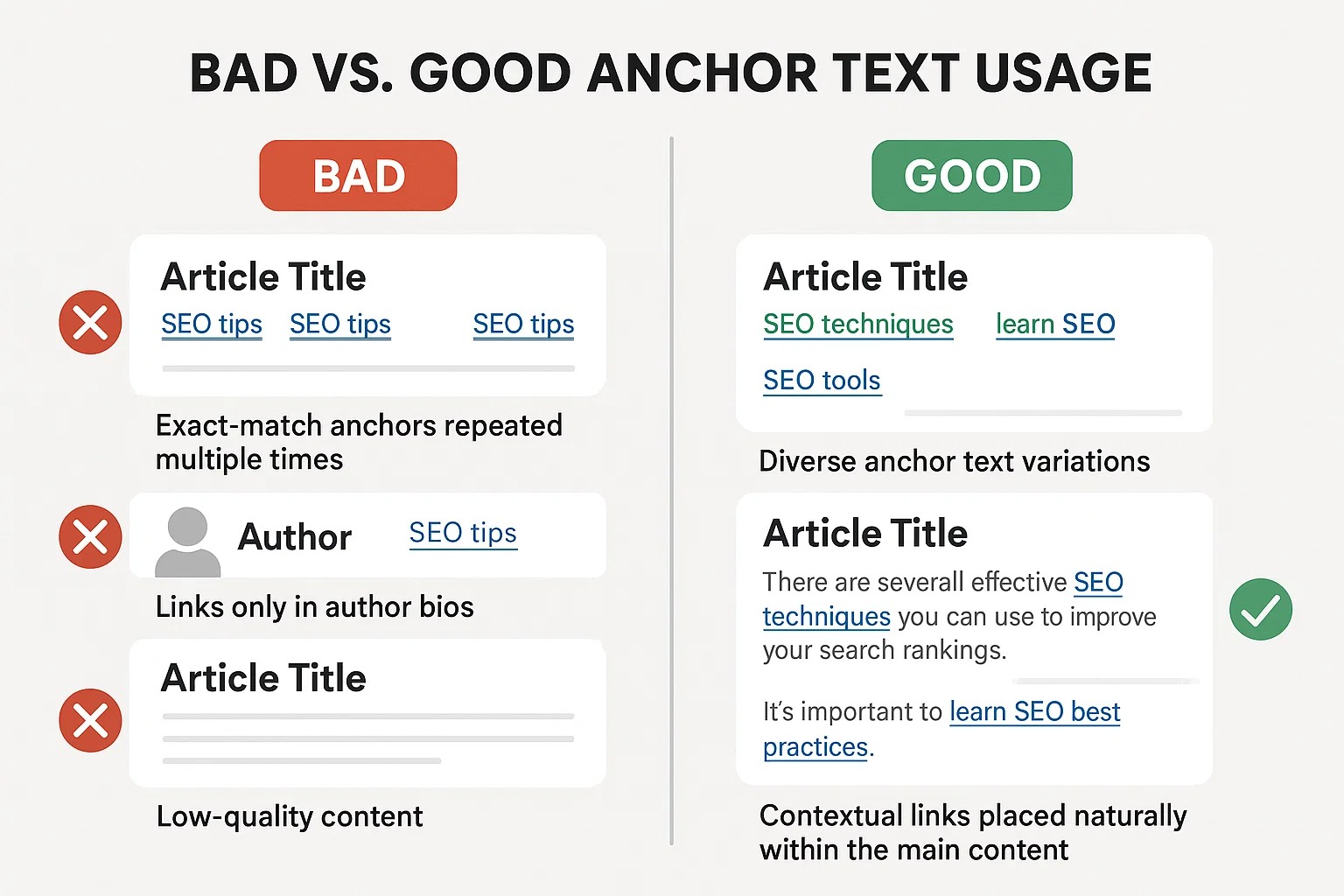
What to Do
Use a mix of branded, keyword+brand, and natural anchor variations
Place contextual links within the first 300 words or core section of the content
Use supporting links (to other authoritative sites) for natural flow
Step 4: Document and Display Your Portfolio
Common Mistakes to Avoid in a Guest Post Portfolio
A well-structured Guest Post Portfolio can significantly boost your credibility, but many SEO professionals and beginners make critical mistakes that reduce its effectiveness. Avoiding these errors is essential if you want your portfolio to attract clients, rank better, and convert leads.
1. Prioritizing Quantity Over Quality
One of the most common mistakes is showcasing too many low-quality guest posts. Having 30+ links from DR 10–20 sites does not add as much value as 8–10 placements on high-quality, niche-relevant domains. Always prioritize authority, traffic, and relevance over volume.
2. Ignoring Niche Relevance
A scattered portfolio with posts in unrelated niches (e.g., tech, health, casino, fashion) can confuse potential clients. Instead, maintain a focused niche identity. For example, if you position yourself as a SaaS SEO expert, your portfolio should primarily include SaaS and marketing-related sites.
3. Over-Optimized Anchor Text
Using too many exact-match keywords like “best guest posting services” can trigger search engine penalties. A natural anchor text profile should include branded, generic, and partial-match anchors to maintain a safe and effective backlink strategy.
4. Not Tracking Performance Metrics
A portfolio without data is just a list of links. Always include performance indicators such as traffic, keyword improvements, indexing status, or ranking gains. This transforms your portfolio from “proof of work” into “proof of results.”
5. Poor Presentation and Organization
Even strong guest posts lose impact if they are poorly presented. Avoid messy spreadsheets or unstructured lists. Instead, use clean dashboards (Notion, Google Sheets, or Rankar.ai) with clear columns like DR, traffic, niche, anchor text, and outcomes.
6. Ignoring Link Maintenance
Many professionals forget to monitor whether their backlinks are still live or indexed. Lost or deindexed links reduce your portfolio’s value. Regular audits ensure your portfolio remains accurate and trustworthy.
Structure your portfolio in a funnel-optimized way. Here's how to display each post:
Website | Domain Rating | Traffic | Link Type | Anchor Text | Niche | Outcome |
68 | 25K | DoFollow | “best email tools” | SaaS | +12 ranking spots | |
42 | 8.9K | DoFollow | “AI SEO strategies” | Marketing | Indexed & traffic spike |
Tools to use for creating and showcasing:
Notion or ClickUp for visual boards
Google Sheets + Data Studio for dashboards
Rankar.ai-generated profile for verified, detailed posts
Industry Best Practices
Best Practices to Follow:
Tiered Link Building: Combine guest posts with supporting tier-2 links to maximize authority.
Geo-Targeted Posts: If your client operates in a specific region (e.g., the USA), target regionally relevant sites.
Mix Free & Paid Placements: Use a combination of organic and paid guest posts to ensure balance.
Monitor Indexation: Use Google Search Console or IndexCheckr to track the indexing status of your guest posts.
Update Old Links: If links are removed, always request for them to be restored or replaced.
Case Study - Freelance Guest Posting Agent → Agency
Client: Adeel Khan (Freelancer → Rankar.ai Agency Partner)
Approach:
Initially, Adeel had 12 guest posts in mixed niches.
He used Rankar.ai to find free guest post sites and RankWriter AI for content creation.
Tracked link performance through Rankar.ai dashboard.
Results:
Signed 5 clients at $400/month retainers
Scaled operations to 3 agents within 4 months
Focused on eCommerce and SaaS niches
Built a visual guest post portfolio with screenshots, DR, links, and outcomes
Used LinkedIn and Fiverr profiles to attract leads
Actionable Insights & Checklist
Here’s what you should aim for in your portfolio:
Build a minimum of 10 posts in your niche
Ensure at least 5 are on DR 40+ sites
Use AI for content, but humanize for tone and formatting
Track indexation and ranking impact
Create a Notion/Google Sheets portfolio
Add screenshots of live URLs and Before/After rankings
Send your portfolio link in proposals, Upwork/Fiverr profiles, or cold outreach
7. Bonus - AI Tools That Can Help
Tool | Use Case |
AI content creation, website finder, backlink tracking | |
Surfer SEO | Optimizing guest post content |
DataForSEO API | Metrics scraping for thousands of domains |
Screaming Frog | Indexation status and outbound links |
ChatGPT with Web Browsing Plugin | Content research and competitor mapping |