
Rankar Comparisons
Moz vs Semrush: Features & Pricing Compared (2026)
Moz vs Semrush comes down to the work you need to deliver. Choose Moz Pro when its core research and monitoring allowances cover your team’s SEO needs. Choose Semrush when the selected SEO package plus other marketing toolkits fit your responsibilities. Ease of use is personal; test the same assignment rather than treating a vendor comparison as a usability study.
Published by Rankar.ai, which also makes SEO software.
Quick comparison
A short side-by-side before the detail. Every line describes what each product actually does rather than marking a box.
| Criterion | Moz Pro | Semrush |
|---|---|---|
| Entry pricing and billing | Entry-level $49/month; Standard $99/month; Medium $179/month; Large $299/month. The entry-level plan is not interchangeable with Standard. Official source · checked 2026-11-18 | Semrush offers SEO, Starter SEO + AI Search, Pro+ SEO + AI Search, and custom-priced Advanced. Localized EUR prices were displayed during the 18 November 2026 check; a current USD checkout price was not verified. Annual monthly equivalents require annual billing. Official source · checked 2026-11-18 |
| Projects, seats and capacity | Standard: 3 sites, 300 keywords, 1 user; Medium: 10 sites, 1,500 keywords, 2 users; Large: 25 sites, 3,000 keywords, 3 users. Official source · checked 2026-11-18 | SEO and Starter each list 5 monitored websites and 500 daily tracked keywords; Pro+ lists 15 websites and 1,500 keywords. Advanced is custom-priced, with 40+ websites and 5,000+ daily tracked keywords on its plan card. Official source · checked 2026-11-18 |
| Keyword research | Keyword Explorer and competitive research are included in the documented product offering. Official source · checked 2026-11-18 | SEO keyword and competitor research are listed in the package; specialist marketing toolkits are separate. Official source · checked 2026-11-18 |
| Backlink research | Link Explorer provides link research. Its proprietary metrics should not be treated as equivalent to another vendor’s scores. Official source · checked 2026-11-18 | Backlink analysis is part of the SEO offering; index superiority is not independently established here. Official source · checked 2026-11-18 |
| Rank tracking | Rank monitoring is included; compare Standard’s 300-keyword capacity with Medium’s 1,500 and Large’s 3,000. Official source · checked 2026-11-18 | Position tracking is included, with keyword capacity determined by the selected tier. Official source · checked 2026-11-18 |
| Technical site audits | Moz advertises 400,000, 2 million and 5 million crawl pages per month on Standard, Medium and Large. Its detailed comparison separately lists weekly allowances of 100,000, 500,000 and 1.25 million respectively. Official source · checked 2026-11-18 | Site audits are included; the shared evidence does not establish a current crawl allowance for each combined plan. Official source · checked 2026-11-18 |
| Reporting and integrations | The plan comparison lists reports and scheduled reports. Branded Reports and Report Templates are not included in Standard; confirm the selected higher tier before promising branded client deliverables. Official source · checked 2026-11-18 | Base Report and Pro Report are separately listed add-ons. Base includes scheduling, PDF export and Google Analytics/Search Console integrations; Pro adds external integrations, branding, white-labeling, AI summaries and link sharing. Additional users are separately priced. Official source · checked 2026-11-18 |
| Free access and trial terms | A free trial is offered on the Medium page; the shared fact sheet did not capture its duration. Official source · checked 2026-11-18 | A free entry tier was captured: one demo project and ten reports per day. Paid-trial duration was not verified. Official source · checked 2026-11-18 |
Moz vs Semrush: the decision that matters
A practical comparison separates the basic SEO subscription from local marketing and other specialist products. Neither a familiar brand name nor a long feature list establishes that listings, additional users or a particular report are included. Ask for the actual plan-level entitlement before committing.
This is an evidence-based desk comparison, not a claim of hands-on benchmarking. Plan facts below come from the official-source fact sheet checked on 12 November 2026, with selected official pages rechecked on 16 November. Prices can vary by region and tax; unknown details remain explicitly unverified. Recommendations describe workflow fit rather than measured product superiority.
Entry pricing and billing
Compare monthly subscriptions with monthly subscriptions, and upfront annual contracts with annual contracts. Check tax, currency, additional users and separately sold products. An annual monthly equivalent is useful for budgeting but does not establish that you can cancel after one month. Do not fill a missing current quote with an older blog’s price.
Moz Pro: Entry-level $49/month; Standard $99/month; Medium $179/month; Large $299/month. The entry-level plan is not interchangeable with Standard. Official pricing. Semrush: Semrush offers SEO, Starter SEO + AI Search, Pro+ SEO + AI Search, and custom-priced Advanced. Localized EUR prices were displayed during the 18 November 2026 check; a current USD checkout price was not verified. Annual monthly equivalents require annual billing. Official pricing. Use the access dates in the table when interpreting these figures.
Projects, seats and capacity
Before buying, make a list of required websites, the people who need access and the work assigned to each site. Project counts can mean different things, and a per-project keyword allowance is not an account-wide allowance. Leave room for onboarding another client rather than selecting a plan that already sits at its limit.
For this matchup, Standard: 3 sites, 300 keywords, 1 user; Medium: 10 sites, 1,500 keywords, 2 users; Large: 25 sites, 3,000 keywords, 3 users. SEO and Starter each list 5 monitored websites and 500 daily tracked keywords; Pro+ lists 15 websites and 1,500 keywords. Advanced is custom-priced, with 40+ websites and 5,000+ daily tracked keywords on its plan card. The official-source table above records the access dates; these are capacity definitions, not interchangeable measures of value.
Keyword research
Use a seed topic from your market and inspect the actual pages shown for candidate phrases. A useful report connects a phrase to intent and a sensible destination page. Search volume and keyword difficulty are modeled estimates, not promised visits or a ranking probability. A low difficulty score does not remove the need for relevant, differentiated content.
Backlink research
A useful backlink investigation moves from a summary metric to an inspectable referring page. Check that the link exists, its destination is correct and its surrounding content is relevant. Different crawler datasets can disagree. Without a controlled sample and a fixed observation window, neither database size nor marketing language proves which product is more accurate.
Ahrefs defines Domain Rating as link popularity relative to other sites and distinguishes it from Moz’s Domain Authority. These scores are not direct substitutes or Google guarantees. Metric explanation · checked 16 November 2026.
Rank tracking
Match country, language, search engine and device before comparing a position. A mobile result is not the same observation as a desktop result. Keep refresh cadence and historical gaps visible. Search Console average position is a different measure from a fresh result-page check and should never silently replace it in a client’s ranking table.
Technical site audits
Check both the per-crawl ceiling and the monthly allowance. A report covering only part of a site cannot establish that the whole site is free of problems. During evaluation, inspect an important page and a known technical issue, then verify the finding in the actual HTML or response. An issue count is not evidence that every flagged item requires the same priority.
Reporting and integrations
Request a sample of the exact deliverable your client needs. Establish whether it can be exported, shared with the right people and reproduced on the selected subscription. API availability is not the same as unlimited API consumption. Report labels should distinguish observed rankings, estimated research values and connected first-party analytics.
Free access and trial terms
A free tool, a paid-plan trial and a money-back guarantee are different arrangements. Check whether a card is required, what is included, when billing begins and how cancellation works. A limited evaluation account can demonstrate the interface without proving that a production workload fits the lowest paid plan.
Who should choose Moz Pro?
Choose Moz Pro when its core research and monitoring allowances cover your team’s SEO needs. Make that choice only after confirming the package covers your required sites and deliverables. If a missing integration or report becomes a recurring manual step, include that time in the buying decision instead of looking only at the subscription price.
Who should choose Semrush?
Choose Semrush when the selected SEO package plus other marketing toolkits fit your responsibilities. Confirm the required entitlement and refresh cadence, and evaluate a representative task before committing to an annual contract. A different team can reasonably choose the other product because its workload is different.
A practical evaluation before you subscribe
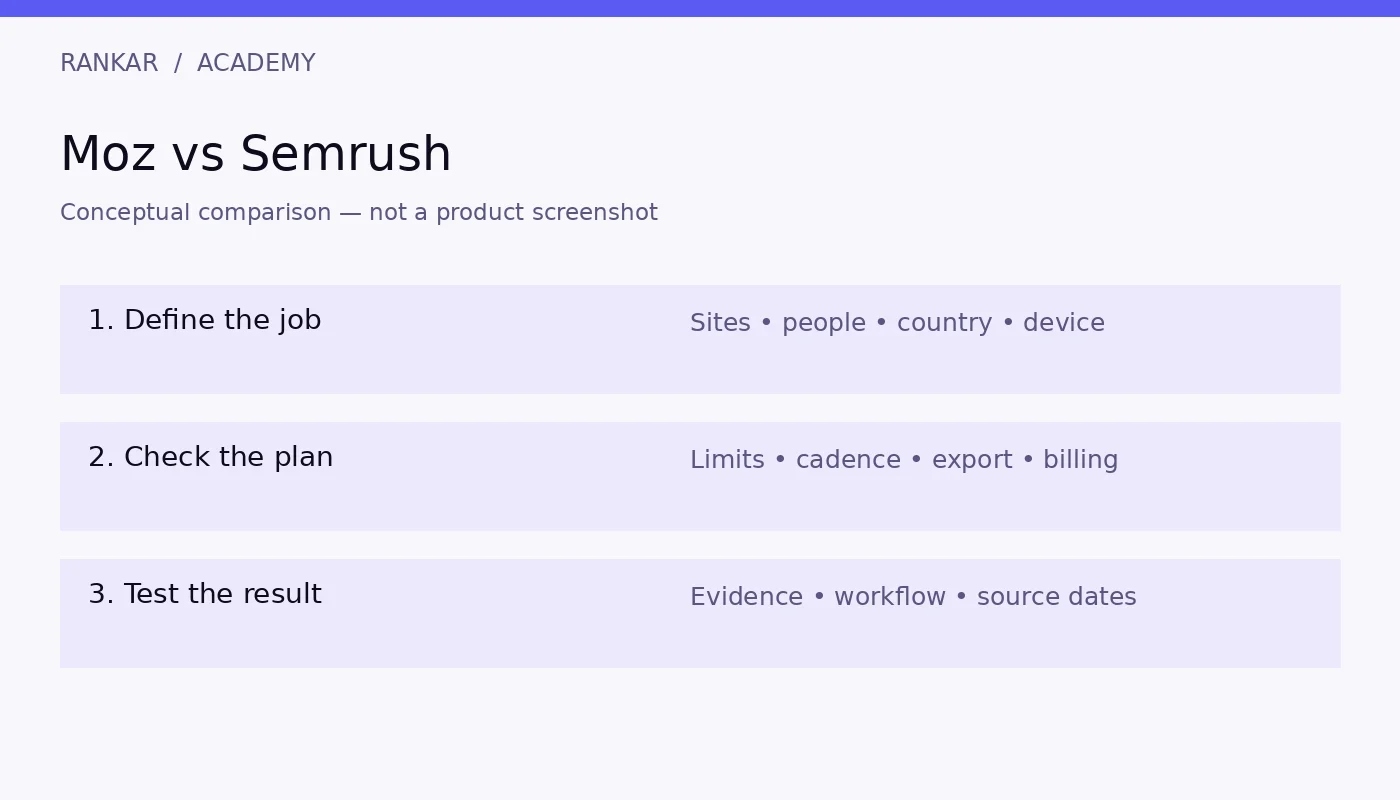
Give the same analyst a keyword brief, a crawl issue and a monthly reporting task in each product. Record steps, missing information and the ability to export the final answer. This is a repeatable evaluation method, not a fabricated statement that we conducted a timed usability test.
Keep the acceptance test small and specific: one completed research brief, one explained technical finding and one report another teammate can reproduce. Record unsupported or unavailable answers rather than award an invented performance score. If both products satisfy the work, compare the total bill and the effort needed to maintain the reporting process.
Other tools to consider
Rankar.ai is another option to evaluate when coordinating SEO work alongside research and reporting. For a separate product comparison, read Moz Pro comparison and Semrush comparison. Keep this buying decision focused on the two products above rather than treat an alternative as the verdict.
Sources and scope
No original timed usability test, controlled backlink-index benchmark or vendor accuracy score is claimed. No guaranteed rankings, traffic gains or customer results are inferred from this comparison. Verify current checkout terms before purchasing.
- Moz Pro: official plans and included features — dated facts in the table; shared fact-sheet observations accessed 12 November 2026. Selected rechecks accessed 16 November 2026.
- Semrush: official plans and included features — dated facts in the table; shared fact-sheet observations accessed 12 November 2026. Selected rechecks accessed 16 November 2026.
Frequently asked questions
This article compares their documented SEO offerings and identifies unverified package details. Local products, premium reporting and specialist marketing tools should be priced separately when required.
Moz’s Standard and Medium allowances make sites, keywords and included seats explicit. Semrush’s package may suit a broader marketing workload. Obtain the full bill for your required seats and toolkits.
No controlled usability test was completed for this draft. Trial both with the same deliverable and assess whether a teammate can obtain and explain the result without rebuilding it elsewhere.
Yes. Research tools use different datasets and models. Compare country, dates and the definition of each metric, and validate owned-site performance against first-party evidence.
Both cover core SEO tasks. The meaningful differences for purchasing are plan capacity, research interfaces, included seats and the separate products or add-ons needed to complete your workflow.
There is no universal winner. Choose a plan that meets the required site, keyword, crawl and reporting work within your budget; do not interpret a larger feature list as proof of a better result.
Keep comparing