
Rankar Academy · Updated 18 November 2026
Best Ways to Track Brand Mentions in AI Search
The best ways to track brand mentions in AI search combine controlled manual checks, Google Search Console, a specialist AI tracker, social listening and repeatable exports. Start with a fixed prompt set, record the engine and search mode, and save the answer alongside its sources. Then compare equivalent runs over time. This measures observed visibility, not every answer users receive, a universal AI ranking or revenue caused by a mention.
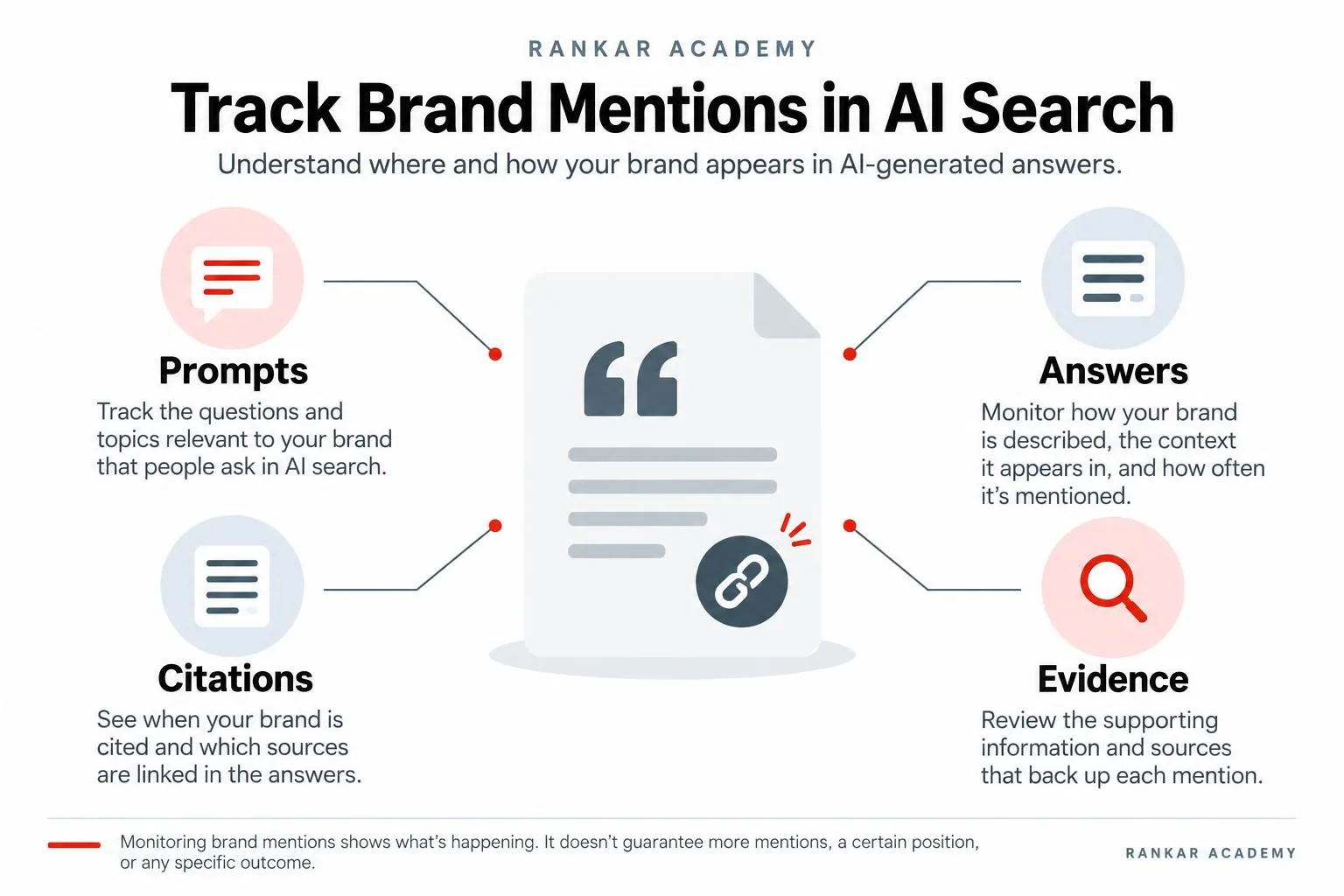
Best ways to track brand mentions in AI search: compare five methods
Choose methods by the evidence you need, not by a dashboard's headline score. Manual checks reveal answer context; Search Console supplies first-party Google visibility data; specialist trackers support repeated sampling; social listening captures public conversation; exports preserve the audit trail. Each method has a different population and different blind spots.
Rankar publishes this guide and offers SEO software. This comparison does not rank vendors or assume that Rankar supports every workflow described. Evaluate any product against the same collection, coverage, provenance and export requirements. A sample report that can be traced to actual answers is more informative than an unexplained score.
- Manual checks reveal the answer, source context and factual errors. Analyst time is the main cost; a check cannot reveal every user's conversation.
- Google Search Console measures your website's Google visibility. It does not provide a census of brand names in all answer text or coverage of competing assistants.
- Specialist AI trackers support recurring prompt samples and competitor reviews. Verify the supported surfaces, collection method, retained evidence and actual subscription allowances.
- Social listening captures public discussion and shared answer screenshots. Accessible posts do not represent private assistant conversations.
- Repeatable exports preserve historical evidence and definitions. An export cannot collect mentions absent from the underlying source.
Is it possible to track brand mentions in AI search?
Yes, within a defined sample. You can record whether an answer names your brand, links to your site, recommends a product or repeats an incorrect claim. You cannot infer complete market visibility from a handful of prompts or inspect other people's private chats. State the sampled audience and questions before collecting evidence.
Keep mention, citation and recommendation separate. A mention is a name appearing in the answer. A citation is a source link, which may point to your domain without naming the business in prose. A recommendation is an evaluative inclusion, not merely an appearance. A negative comparison is still a mention, but it must not count as a positive recommendation.
Separate the engine from the model. ChatGPT, Perplexity, Gemini Apps and Google Search are different products or surfaces. A model label does not fully describe retrieval, interface behavior or source availability. Record the displayed model when available; otherwise write not disclosed rather than guessing. Treat consumer-interface and API observations as different collection methods.
How to track brand mentions in AI search
Build a prompt library around real buying questions: category discovery, feature requirements, comparisons, pricing concerns and location-specific needs. Keep branded diagnostic prompts separate from unbranded discovery prompts. Asking about your company directly measures a different opportunity from appearing unprompted. Include questions where a competitor could reasonably be mentioned, not only prompts designed to elicit your own brand.
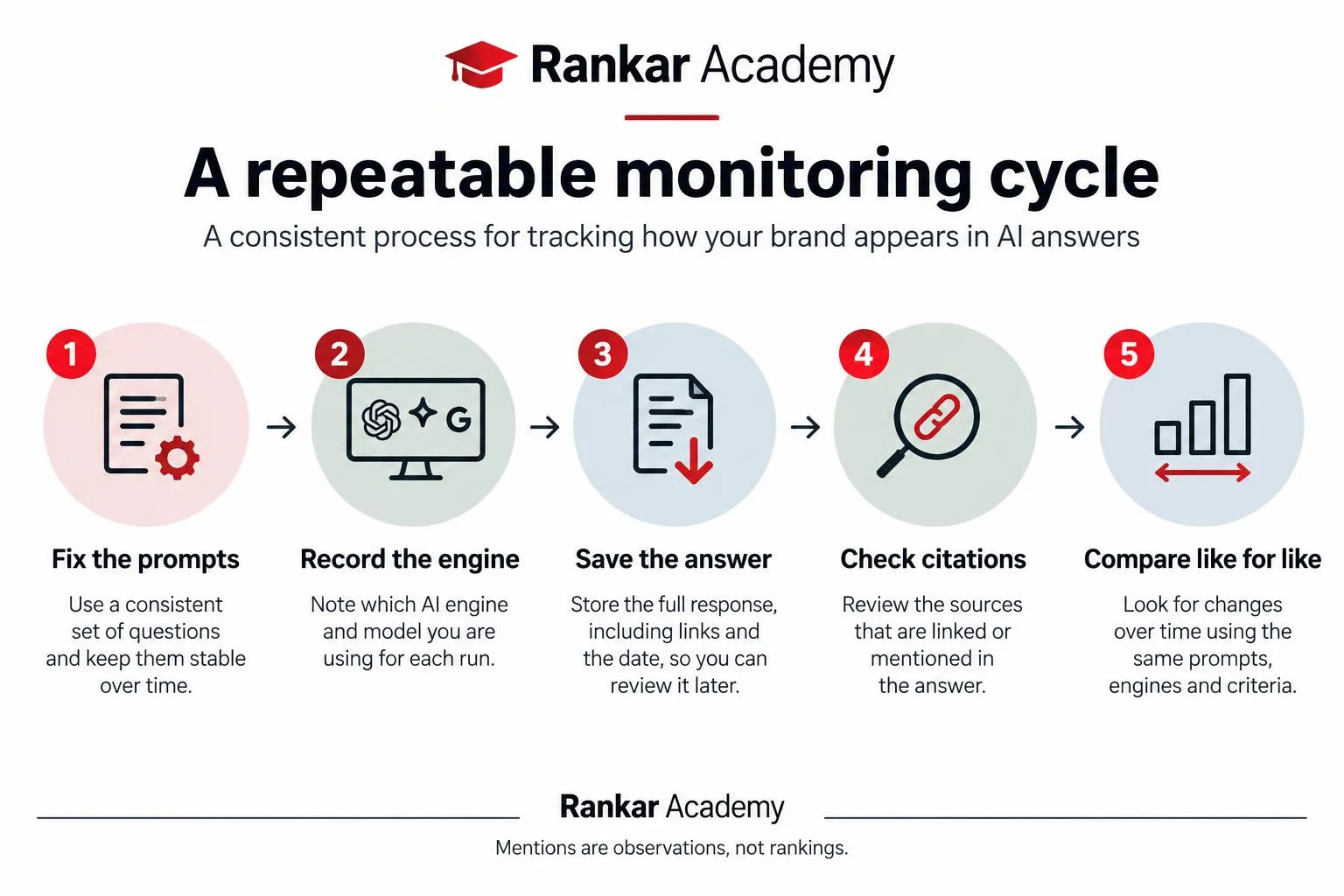
For each prompt, define audience, intent, country, language, engine and search mode. Preserve exact wording and assign a stable identifier. When wording changes, create a new version instead of silently replacing the old prompt. Country means the tested location context, not simply a country named in the question. Record unavailable location controls explicitly.
Start a fresh conversation for baseline checks and record account conditions, memory or personalization settings where controllable, date, time and timezone. Save the complete answer before classifying it. Record whether the result used web search, exposed citations or refused the request. A new conversation reduces one source of variation but does not make all account or product conditions identical.
Collect repeated observations on a consistent schedule. Keep failed runs, refusals, missing AI features and unavailable sources as distinct outcomes. Dropping inconvenient observations can make a report look stronger without producing better evidence. Preserve historical answers rather than overwriting a baseline when a new run completes.
How to see brand mentions in ChatGPT
Use ChatGPT's web-search experience when the question concerns search visibility. OpenAI explains that ChatGPT can search automatically when useful or users can select Search, and web-search answers can include source links. Record whether the observed answer actually used search; do not assume every response did. OpenAI search documentation.
Read the full answer, expand available sources and inspect whether the brand appears in the narrative, a linked page or both. Save the exact passage and destination URL. A source about your company is not necessarily a recommendation. Check whether the linked page is yours, an independent article or a different business with the same name.
For branded checks, look for outdated product names, mistaken ownership, unsupported comparisons and confusion with similarly named businesses. These checks diagnose factual representation; do not blend them into an unbranded discovery score. Keep a list of accepted aliases and review ambiguous matches manually rather than treating every substring as a confirmed mention.
Monitor brand mentions in ChatGPT
Turn individual checks into a repeatable observation panel. Retain prompt wording, run conditions, answer text, visible citations and an evidence reference. A screenshot preserves layout; copied text supports searching and classification. Use both where permitted and practical. Store the citation URL as displayed and record any destination change discovered during verification.
Review whether apparent gains survive equivalent reruns. Changes may reflect retrieved sources, conversation context, product updates, model changes or ordinary response variation. Label a changed model or collection method as a new reporting segment. Do not connect unlike samples with a continuous trend simply because both contain the same brand.
For an automated collector, ask whether it observes the consumer interface, uses an API or relies on another provider's results. An API workflow may be useful, but it is not automatically identical to the consumer ChatGPT experience. Use approved collection methods, respect platform terms and avoid uploading confidential customer prompts or personal information merely to make a dataset realistic.
Best ways to monitor brand mentions in AI search
Apply the same evidence checklist across engines while respecting their differences. To track brand mentions in Perplexity, preserve the answer and inspect its numbered sources. Perplexity describes searching the web and returning answers with cited sources. A citation still requires review for relevance and accuracy. Perplexity documentation.
For Gemini, distinguish a brand name from a source or related link. Google says Gemini Apps may show sources and related content within or below responses; these can include public websites or connected material. Record the actual context instead of treating every related link as proof of answer provenance. Gemini source guidance.
Track Google AI Overviews and AI Mode separately from Gemini Apps. They are Google Search features with supporting links, so brand visibility in AI Overview results is a different observation from visibility inside the Gemini app. Google AI-feature guidance.
A specialist tracker helps when scheduled collection, shared review or repeatable competitor samples justify its cost. Before buying, verify supported surfaces, countries, languages, model disclosure, retained evidence, failed-run handling and export availability using a real trial dataset. Ask how many prompts and engine checks the selected package includes; prompt capacity is not necessarily the number of responses you can collect.
How to track brand mentions in AI search results
Use Search Console for the Google evidence it actually provides, not as a substitute for answer-text monitoring. Google's June 2026 documentation announces dedicated Search Generative AI performance reports for site visibility in AI features, including AI Overviews and AI Mode. It describes impressions and breakdowns by pages, countries, devices and dates, with these observations also included in overall performance reporting. Google reporting announcement.
Inspect report definitions available in your own property before building a dashboard. Record the report name, filters, dimensions and reporting window. Do not repeat an older claim that Search Console can never distinguish AI-feature visibility without checking current documentation. A documented reporting feature does not establish that you have fetched or measured it for this project.
These reports concern your site's visibility, not every textual mention of your brand, competitors' complete exposure or responses in other assistants. Keep first-party Google reporting alongside prompt samples instead of combining them into a supposedly universal score. Use social listening separately: a shared screenshot is an incident lead, not proof the same answer appeared broadly.
Build repeatable exports and defensible metrics
Create a durable record for each observation. Export raw answers and normalized fields where permitted. Keep an unchanged evidence copy separate from analyst labels so later reviewers can challenge a classification without losing the original. Restrict access to customer-specific research and apply a retention policy appropriate to the information collected.
Useful fields include prompt ID and version, engine, surface, displayed model, search mode, country, language, timestamp, collection method, run status, brand alias matched, mention passage, cited URL and evidence location. Add reviewer notes for ambiguous cases. A hostname match should respect domain boundaries rather than matching any URL that happens to contain your brand's domain string.
Define mention rate as valid sampled answers containing the brand divided by valid sampled answers in that segment. Define citation rate separately using answers linking to the agreed domain set. Show the denominator and excluded-run count beside each result. Unscored sentiment is unknown, not automatically neutral; unavailable comparison values cannot support a percentage-point change.
These are sample metrics, not audience reach, search volume or a universal ranking. For competitor share of mentions, specify whether the numerator counts answers, occurrences or unique brands. Compare equivalent prompt versions, countries, languages, surfaces, collection methods and equal-length windows. Keep exploratory additions separate and annotate collection breaks. An empty sample is unavailable, not zero visibility.
How to improve brand visibility in AI search engines
Use evidence to choose a specific problem. If your brand is absent from relevant discovery answers, review whether authoritative pages clearly explain the category, audience, capabilities and limitations. If answers contain factual errors, correct your documentation and identify third-party sources repeating the mistake. Keep an intervention log showing what changed, affected pages and when the change became public.
Google says established SEO best practices remain relevant to its AI features and no additional requirements or special optimizations are needed for inclusion. Eligibility does not promise appearance. Google AI-feature guidance.
Prioritize accessible, useful pages with clear facts, descriptive internal links and evidence supporting substantive claims. Maintain product and organizational names consistently. Accurate third-party coverage may corroborate your pages, but do not manufacture endorsements or purchase misleading mentions. Explain what the product cannot do as carefully as what it does. Recheck affected prompts after publication while retaining the original baseline.
Best ways to improve brand visibility in AI search results
Match the fix to the failure. Missing product facts call for clearer documentation; unsupported comparisons call for verifiable criteria; weak local representation calls for accurate service and location information. Repeating a keyword across unrelated pages does not resolve these problems. Assign each intervention an owner and a publication date so subsequent reviews have usable context.
Inspect sources in answers where competitors appear. Ask what useful information they provide that your equivalent page lacks: an explicit definition, current specification, transparent methodology or directly relevant example. Improve usefulness rather than copying sentence patterns. A proprietary tracker score alone does not establish a content gap; inspect the original answer.
After publishing, rerun the unchanged baseline panel. A new citation is worth recording, but it does not prove one edit caused it. Retrieval changes, competitors, product updates and timing remain alternative explanations. For business reporting, separate visibility, visits and outcomes. Analytics can show identifiable referral traffic where tracking permits; it cannot reconstruct all private journeys or establish causal ROI for every unclicked mention.
FAQ: agency that tracks brand mentions in ChatGPT and Perplexity
What should an agency deliver? Ask for its prompt inventory, engine and country coverage, collection method, raw evidence, competitor definitions, exception handling and reusable exports. Require separate reporting for branded diagnosis and unbranded discovery. Confirm who owns the dataset and what remains accessible when the engagement ends.
Request a sample report and trace several findings to their original answers. Check whether recommendations address observed errors rather than a proprietary score alone. Reject guaranteed ChatGPT placement, guaranteed Perplexity inclusion and promises that a citation produces a particular revenue outcome. A credible provider describes sampling limits and distinguishes monitoring from optimization.
FAQ: best practices for improving brand visibility in AI search
Which tool should you choose? The best tool for tracking brand visibility in ChatGPT depends on occasional checking, recurring evidence collection, competitor analysis and reporting needs. Test the same prompts against shortlisted products and compare coverage, provenance, exports and total workflow cost. A cheap plan that cannot retain evidence may create more analyst work than it saves.
How often should you check? Choose a cadence suited to your decision cycle and review capacity. Consistent conditions and evidence retention matter more than frequent snapshots nobody validates. Can useful content guarantee mentions? No: engines control retrieval and answer generation. Monitoring reduces uncertainty rather than manufacturing certainty.
Explore RankAIO, read the competitor AI visibility guide and learn about getting cited in ChatGPT, Perplexity and AI Overviews. These are related learning resources, not evidence that a particular feature produced ranking gains.
Frequently asked questions
Is it possible to track brand mentions in AI search?
Yes, within a defined sample. Save the exact prompt, engine, date and answer, then distinguish a brand mention from a citation or recommendation. A sample cannot establish visibility across every private conversation.
How can I see brand mentions in ChatGPT?
Run a fixed set of relevant questions, record the displayed search mode and inspect the answer for your brand and domain. Keep branded diagnostic prompts separate from unbranded discovery prompts, and preserve the answer rather than reporting only a score.
How should I track brand mentions in Perplexity?
Use repeatable prompts and record the tested mode, language and date. Save the answer and inspect its cited sources separately: a domain citation may appear without a brand name. Compare equivalent runs, not different engines or changed prompts.
What are the best practices for improving brand visibility in AI search?
Correct factual errors, publish clear and useful product information, keep names consistent and support substantive claims with evidence. Recheck an unchanged prompt panel after publication. Eligibility and helpful content do not guarantee a mention, citation or ranking.